
Pure human recombinant protein
Technical Support & Resources

Visit our FAQ

Contact Us

Toll Free Phone (USA and Canada Only): (888) 526-5351
Direct Phone: (734) 975-3888

Request Technical Support

Technical Support Request

To streamline the process attach the appropriate questionnaire to your inquiry.

Download IHC QuestionnaireDownload WB Questionnaire

View Our Privacy Statement for details on how we use and protect your data. In addition, this site is protected by hCaptcha and its Privacy Policy and Terms of Service apply.

UHRF1 tudor-like region (human recombinant; His-tagged)

Item No. 14779
Technical Information
Synonyms
  • E3 Ubiquitin-protein Ligase UHRF1
  • Inverted CCAAT Box Binding Protein of 90 kDa
  • Nuclear Protein 95
  • RING Finger Protein 106
  • Transcription Factor ICBP90
  • Ubiquitin-like PHD and RING Finger Domain-containing Protein 1
Purity
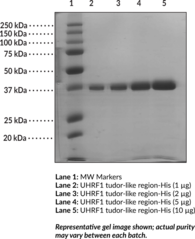
≥95% estimated by SDS-PAGE
Source
Recombinant protein expressed in E. coli
Amino Acids
126-286 (partial protein)
MW
31.9 kDa
50 mM Tris, pH 8.0, containing 150 mM sodium chloride, 2.2 mM potassium chloride, 10 mM β-mercaptoethanol, and 20% glycerol
License
SUMOpro tag was used under non-exclusive license from LifeSensors, Inc.
UniProt Accession №
Q96T88
Shipping & Storage Information
Storage
-80°C
Shipping
Dry ice in continental US; may vary elsewhere
Recommended Products

Certificates of Analysis & Batch Specific Data

Provide batch numbers separated by commas to download or request available product inserts, QC sheets, certificates of analysis, data packs, and GC-MS data.

    Add

    Product Description

    Tudor domains (or tudor-like regions) are small protein structural motifs of ~50 amino acids related to the “Royal Family” of methyl readers, which also includes chromo, malignant brain tumor (MBT), PWWP, and Agenet-like domains.1,2 Tudor domains occur either alone, in tandem, or with other domains and are found in many proteins that are involved in RNA metabolism, germ cell development, transposon silencing, DNA damage response, histone modification, and chromatin remodeling.3 The tudor domains recognize symmetric methylated arginine or methylated lysine residues.4,5,6,7 Ubiquitin-like with PHD and ring finger domains 1 (UHRF1) is a multidomain-containing nuclear protein known to bind chromatin and participate in the maintenance of DNA methylation.8,9 The SET and RING associated domain of UHRF1, also called the YDG motif, binds methyl cytosines, while trimethylated histone H3 lysine 9 (H3K9me3) and unmethylated histone H3 Arginine 2 (H3R2me0) are recognized by the tandem tudor-like domains and the PHD domain, respectively.10,11,12,13,14,15 Some evidence suggests the tandem tudor-like region and adjacent PHD domain may operate together to recognize H3K9me3.16 The combinatorial recognition of the histone tail region and hemi-methylated DNA functions to regulate gene silencing by directly interacting with DNA (cytosine-5)-methyltransferase 1.17,8,18 UHRF1 also posseses E3 ubiquitin ligase activity toward histone H3 and the tumor suppressor promyelocytic leukemia protein.13,19 Binding of UHRF1 tandem tudor-like domains to H3K9me3 is involved in heterochromatin formation and maintenance.13 This protein product contains the tudor-like region of UHRF1.

    WARNING This product is not for human or veterinary use.

    References & Product Citations
    Product Description References

    1. Maurer-Stroh, S., Dickens, N.J., Hughes-Davies, L., et alThe Tudor domain 'Royal Family': Tudor, plant Agenet, Chromo, PWWP and MBT domains. Trends Biochem. Sci. 28(2), 69-74 (2003).

    2. Lasko, P. Tudor domain. Curr. Biol. 20(16), R666-R667 (2010).

    3. Chen, C., Nott, T.J., Jin, J., et alDeciphering arginine methylation: Tudor tells the tale. Nat. Rev. Mol. Cell Biol. 12(10), 629-642 (2011).

    4. Kim, J., Daniel, J., Espejo, A., et alTudor, MBT and chromo domains gauge the degree of lysine methylation. EMBO Rep. 7(4), 397-403 (2006).

    5. Huang, Y., Fang, J., Bedford, M.T., et alRecognition of histone H3 lysine-4 methylation by the double tudor domain of JMJD2A. Science 312(5774), 748-751 (2006).

    6. Lee, J., Thompson, J.R., Botuyan, M.V., et alDistinct binding modes specify the recognition of methylated histones H3K4 and H4K20 by JMJD2A-tudor. Nat. Struct. Mol. Biol. 15(1), 109-111 (2008).

    7. Sprangers, R., Groves, M.R., Sinning, I., et alHigh-resolution X-ray and NMR structures of the SMN tudor domain: Conformational variation in the binding site for symmetrically dimethylated arginine residues. J. Mol. Biol. 327(2), 507-520 (2003).

    8. Bostick, M., Kim, J.K., Estève, P.O., et alUHRF1 plays a role in maintaining DNA methylation in mammalian cells. Science 317(5845), 1760-1764 (2007).

    9. Hopfner, R., Mousli, M., Jeltsch, J.M., et alICBP90, a novel human CCAAT binding protein, involved in the regulation of topoisomerase II α expression. Cancer Res. 60(1), 121-128 (2000).

    10. Unoki, M., Nishidate, T., and Nakamura, Y. ICBP90, an E2F-1 target, recruits HDAC1 and binds to methyl-CpG through its SRA domain. Oncogene 23(46), 7601-7610 (2004).

    11. Sharif, J., Muto, M., Takebayashi, S.i., et alThe SRA protein Np95 mediates epigenetic inheritance by recruiting Dnmt1 to methylated DNA. Nature 450(7171), 908-912 (2007).

    12. Avvakumov, G.V., Walker, J.R., Xue, S., et alStructural basis for recognition of hemi-methylated DNA by the SRA domain of human UHRF1. Nature 455(7214), 822-825 (2008).

    13. Karagianni, P., Amazit, L., Qin, J., et alICBP90, a novel methyl K9 H3 binding protein linking protein ubiquitination with heterochromatin formation. Mol. Cell. Biol. 28(2), 705-717 (2008).

    14. Hu, L., Li, Z., Wang, P., et alCrystal structure of PHD domain of UHRF1 and insights into recognition of unmodified histone H3 arginine residue 2. Cell Res. 21(9), 1374-1378 (2011).

    15. Lallous, N., Legrand, P., McEwen, A.G., et alThe PHD finger of human UHRF1 reveals a new subgroup of unmethylated histone H3 tail readers. PLoS One 6(11), e27599 (2011).

    16. Xie, S., Jakoncic, J., and Qian, C. UHRF1 double tudor domain and the adjacent PHD finger act together to recognize K9me3-containing histone H3 tail. J. Mol. Biol. 415(2), 318-328 (2012).

    17. Felle, M., Joppien, S., Németh, A., et alThe USP7/Dnmt1 complex stimulates the DNA methylation activity of Dnmt1 and regulates the stability of UHRF1. Nucleic Acids Res. 39(19), 8355-8365 (2011).

    18. Rothbart, S.B., Krajewski, K., Nady, N., et alAssociation of UHRF1 with methylated H3K9 directs the maintenance of DNA methylation. Nat. Struct. Mol. Biol. 19(11), 1155-1160 (2012).

    19. Guan, D., Factor, D., Liu, Y., et alThe epigenetic regulator UHRF1 promotes ubiquitination-mediated degradation of the tumor-suppressor protein promyelocytic leukemia protein. Oncogene 32(33), 3819-3828 (2013).

