
Features
- Due to limited shelf life and/or restricted production, this product is available as custom order only. Please contact our sales office for pricing and lead time.
- Cayman’s BRD3 bromodomains 1 and 2 TR-FRET Assay Kit (Item No. 600820) was developed using BRD3 bromodomain 1 and 2 (human, recombinant) protein
- Bulk sizes available upon request
Technical Support & Resources
Visit our FAQ
Contact Us
Toll Free Phone (USA and Canada Only): (888) 526-5351
Direct Phone: (734) 975-3888
Product Categories
Product Type
Application
BRD3 bromodomains 1 and 2 (human, recombinant)
Item No. 14864
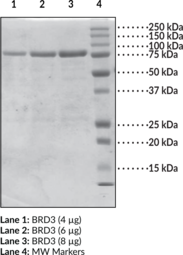
Technical Information
- Bromodomain containing protein 3
- ORFX
- RING3L
- RING3-
like protein
Shipping & Storage Information
Recommended Products
Certificates of Analysis & Batch Specific Data
Provide batch numbers separated by commas to download or request available product inserts, QC sheets, certificates of analysis, data packs, and GC-MS data.

Visit Our Cancer Resource Center
Find Tools & Resources to Study the Hallmarks of Cancer
- Cancer cell signaling & regulation
- Cancer metabolism
- Tumor microenvironment
Product Description
Bromodomain-containing protein 3 (BRD3) is a member of the bromodomain and extra-terminal domain (BET) family.1 It is composed of two N-terminal bromodomains (BD1 and BD2) that bind acetylated lysine on histones, serving to couple histone acetylation marks to the transcriptional regulation of target promoters, and an extra-terminal domain that mediates chromatin interactions. BRD3 is ubiquitously expressed and localizes to the nucleus where it preferentially binds acetylated histone H4 lysine 5 (H4K5), H4K12, and H4K14 at active transcription sites.2,3 Knockdown of Brd3 enhances differentiation of C2C12 skeletal muscle myoblasts.4 Chromosomal translocations leading to the fusion of BRD3 with the nuclear protein in testis (NUT) gene and resulting in expression of BRD3-NUT fusion proteins are associated with NUT midline carcinoma (NMC).5 Cayman’s BRD3 bromodomains 1 and 2 protein can be used for Western blot (WB).
WARNING This product is not for human or veterinary use.
References & Product Citations
1. WHAT do viruses BET on? Front. Biosci. (Landmark Ed.) 15, 537-549 (2010).
2. Chromosomal localization, gene structure and transcription pattern of the ORFX gene, a homologue of the MHC-
3. The double bromodomain proteins Brd2 and Brd3 couple histone acetylation to transcription. Mol. Cell 30(1), 51-60 (2008).
4. BRD3 and BRD4 BET bromodomain proteins differentially regulate skeletal myogenesis. Sci. Rep. 7(1), 6153 (2017).
5. BRD-
Contact Info
Cayman Chemical1180 East Ellsworth RoadAnn Arbor, Michigan 48108 USAToll Free: (800) 364-9897(USA and Canada only)Fax: (734) 971-3640


