
Technical Support & Resources
Information provided in the product description is from published literature. Due to the nature of scientific experimentation, your results (e.g., selectivity and effective concentrations) or specific application for this product may differ. If you have questions about how this product fits your application, please contact our technical support staff.
Visit our FAQ
Contact Us
Toll Free Phone (USA and Canada Only): (888) 526-5351
Direct Phone: (734) 975-3888
Product Categories
Research Area
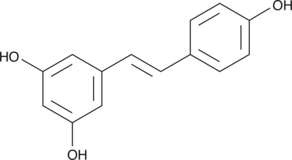
Resveratrol-3-O-Sulfate (sodium salt)
Item No. 14942

Technical Information
Shipping & Storage Information
Recommended Products




Certificates of Analysis & Batch Specific Data
Provide batch numbers separated by commas to download or request available product inserts, QC sheets, certificates of analysis, data packs, and GC-MS data.
Lipid Resource Center
Discover Products & Resources for Lipid Research
- High-purity lipid standards
- Lipid roles in biology
- Lipids in health & disease
- Lipids for pharmaceutical development
- Protocols, advice, & resources
Product Description
Resveratrol-3-O-sulfate is a metabolite of resveratrol (Item Nos. 70675 | 10004235).1 In U-937 cells stimulated with LPS, resveratrol-3-O-sulfate (1 µM) decreases the expression of IL-1α, IL-1β, and IL-6 by 61.2, 76.6, and 42.2%, respectively, and decreases the release of TNF-α and IL-6 to similar levels as resveratrol. It has antioxidant activity in a Trolox assay, dose-dependently decreases growth of Caco-2 colorectal adenocarcinoma cells when used at concentrations ranging from 10 to 100 µM, and induces apoptosis at concentrations of 25 and 50 µM.2 Resveratrol-3-O-sulfate also displaces rosiglitazone (Item No. 71740) from the outer mitochondrial protein mitoNEET (IC50 = 3.36 µM for the human protein), indicating that it binds to the thiazolidine-2,4-dione (TZD) binding pocket.3
WARNING This product is not for human or veterinary use.
References & Product Citations
1. Resveratrol and its metabolites inhibit pro-
2. Resveratrol metabolites have an antiproliferative effect on intestinal epithelial cancer cells. Food Chem. 134(3), 1385-1391 (2012).
3. A novel binding assay identifies high affinity ligands to the rosiglitazone binding site of mitoNEET. Bioorg. Med. Chem. Lett. 21(18), 5498-5501 (2011).
Contact Info
Cayman Chemical1180 East Ellsworth RoadAnn Arbor, Michigan 48108 USAToll Free: (800) 364-9897(USA and Canada only)Fax: (734) 971-3640


