
Technical Support & Resources
Information provided in the product description is from published literature. Due to the nature of scientific experimentation, your results (e.g., selectivity and effective concentrations) or specific application for this product may differ. If you have questions about how this product fits your application, please contact our technical support staff.
Visit our FAQ
Contact Us
Toll Free Phone (USA and Canada Only): (888) 526-5351
Direct Phone: (734) 975-3888
Product Categories
Technical Information
- BRL 49653
Shipping & Storage Information
Recommended Products
Certificates of Analysis & Batch Specific Data
Provide batch numbers separated by commas to download or request available product inserts, QC sheets, certificates of analysis, data packs, and GC-MS data.
Lipid Resource Center
Discover Products & Resources for Lipid Research
- High-purity lipid standards
- Lipid roles in biology
- Lipids in health & disease
- Lipids for pharmaceutical development
- Protocols, advice, & resources
Product Description
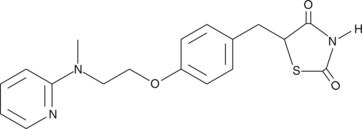
Rosiglitazone is an agonist of peroxisome proliferator-activated receptor γ (PPARγ).1 It activates PPARγ1 and PPARγ2 in reporter assays (EC50s = 30 and 100 nM, respectively). Rosiglitazone selectively activates chimeras containing the ligand-binding domains (LBDs) of PPARγ over PPARα and PPARδ in a cell-based reporter assay at 10 mM. It induces differentiation of C3H10T1/2 stem cells into adipocytes when used at a concentration of 1 µM. Rosiglitazone is also an inhibitor of long-chain acyl-CoA synthetase 4 (ACSL4; IC50 = 0.5 µM).2,3 It inhibits RSL3-induced ferroptosis in Gpx4 Cre-lox-expressing mouse embryonic fibroblasts (Pfa1) cells and Pparg knockout (KO) cells and increases survival in a Gpx4 KO mouse model of ferroptosis when used at a concentration of 0.0125 mg/ml in the drinking water. It decreases hemoglobin A1c (HbA1c) and fasting blood glucose levels in a rat model of type 2 diabetes induced by streptozotocin (STZ; Item No. 13104) and a high-carbohydrate and high-fat diet when administered at a dose of 4 mg/kg.4 Formulations containing rosiglitazone have been used to improve glycemic control in the treatment of type 2 diabetes.
WARNING This product is not for human or veterinary use.
References & Product Citations
1. An antidiabetic thiazolidinedione is a high affinity ligand for peroxisome proliferator-
2. Expression and characterization of recombinant rat Acyl-
3. ACSL4 dictates ferroptosis sensitivity by shaping cellular lipid composition. Nat. Chem. Biol. 13(1), 91-98 (2017).
4. Chronic effects of berberine on blood, liver glucolipid metabolism and liver PPARs expression in diabetic hyperlipidemic rats. Biol. Pharm. Bull. 31(6), 1169-1176 (2008).
Article polyunsaturated lipid senolytics exploit a ferroptotic vulnerability in senescent cells. Cell Press Blue 1(1), 100004 (2026).
Head-
A first-
Enzymatic activity of HPGD in Treg cells suppresses Tconv cells to maintain adipose tissue homeostasis and prevent metabolic dysfunction. Immunity 50(5), 1232-1248 (2019).
Idebenone and coenzyme Q10 are novel PPARα/γ ligands, with potential for treatment of fatty liver diseases. Dis. Model Mech. 11(9), (2018).
DEHP deregulates adipokine levels and impairs fatty acid storage in human SGBS-
Ligand and target discovery by fragment-
Characterization of immortalized human brown and white pre-
VCE-
Cyclic stretch facilitates myogenesis in C2C12 myoblasts and rescues thiazolidinedione-
An siRNA-
Synergistic antiproliferative effects of combined g-
A high-
Peroxisome proliferator-
Contact Info
Cayman Chemical1180 East Ellsworth RoadAnn Arbor, Michigan 48108 USAToll Free: (800) 364-9897(USA and Canada only)Fax: (734) 971-3640


