
Pure human recombinant protein
Technical Support & Resources

Visit our FAQ

Contact Us

Toll Free Phone (USA and Canada Only): (888) 526-5351
Direct Phone: (734) 975-3888
Request Technical Support

Technical Support Request

To streamline the process attach the appropriate questionnaire to your inquiry.

Download IHC QuestionnaireDownload WB Questionnaire

View Our Privacy Statement for details on how we use and protect your data. In addition, this site is protected by hCaptcha and its Privacy Policy and Terms of Service apply.

CBX3 (human recombinant)

Item No. 15467

Technical Information
Synonyms
  • Chromobox Protein Homolog 3
  • Heterochromatin Protein 1 Homolog γ
  • HP1-γ
Purity
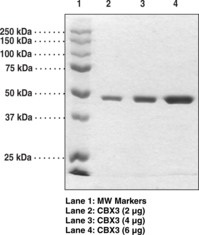
≥95% (estimated by SDS-PAGE)
Source
Recombinant N-terminal GST-tagged protein expressed in E. coli
Amino Acids
2-183 (full length)
MW
48.4 kDa
50 mM Tris, pH 7.4, containing 150 mM sodium chloride and 20% glycerol
UniProt Accession №
Q13185
Shipping & Storage Information
Storage
-80°C
Shipping
Dry ice in continental US; may vary elsewhere
Recommended Products

Certificates of Analysis & Batch Specific Data

Provide batch numbers separated by commas to download or request available product inserts, QC sheets, certificates of analysis, data packs, and GC-MS data.

    Add

    Cayman Chemical
    Visit Our Cancer Resource Center
    Find Tools & Resources to Study the Hallmarks of Cancer
    • Cancer cell signaling & regulation
    • Cancer metabolism
    • Tumor microenvironment
    EXPLORE NOW
    Product Description

    The heterochromatin protein 1 (HP1) family, which consists of isoforms HP1-α (CBX5), HP1-β (CBX1), and HP1-γ (CBX3), are chromatin-associated proteins involved in gene regulation and heterochromatin formation.1 CBX proteins have an N-terminal chromodomain, a C-terminal chromoshadow domain, and a hinge domain that connects the two.2 Extensive post-translational modifications have been observed and mapped on the CBX proteins.3 The chromodomain of CBX3 has been shown to recognize methylated histone H3 lysine 9, methylated histone H1 lysine 26, and G9A methylated at lysine 185.4 CBX3 associates with the exons of a subset of actively transcribed genes, and loss of CBX3 results in accumulation of unspliced mRNA from that subset of genes.5,6 Further, CBX3 suppresses Nanog gene transcription in pre-induced pluripotent stem cells and long terminal repeat protein expression in HIV-1 infected cells.6,7 Knockdown of CBX3 by siRNA in cells latently infected with HIV-1 leads to virus reactivation.8 CBX3 has been proposed to be a biomarker for tumor stem cells in osteosarcoma.9

    WARNING This product is not for human or veterinary use.

    References & Product Citations
    Product Description References

    1. Lachner, M., O'Carroll, D., Rea, S., et alMethylation of histone H3 lysine 9 creates a binding site for HP1 proteins. Nature 410(6824), 116-120 (2001).

    2. Kwon, S.H., and Workman, J.L. The changing faces of HP1: From heterochromatin formation and gene silencing to euchromatic gene expression. BioEssays 33(4), 280-289 (2011).

    3. LeRoy, G., Weston, J.T., Zee, B.M., et alHeterochromatin protein 1 is extensively decorated with histone code-like post-translational modifications. Mol. Cell. Proteomics 8(11), 2432-2442 (2009).

    4. Ruan, J., Ouyang, H., Amaya, M.F., et alStructural basis of the chromodomain of Cbx3 bound to methylated peptides from histone H1 and G9a. PLoS One 7(4), e35376 (2012).

    5. Smallwood, A., Hon, G.C., Jin, F., et alCBX3 regulates efficient RNA processing genome-wide. Genome Res. 22(8), 1426-1436 (2012).

    6. Sridharan, R., Gonzales-Cope, M., Chronis, C., et alProteomic and genomic approaches reveal critical functions of H3K9 methylation and heterochromatin protein-1γ in reprogramming to pluripotency. Nat. Cell Biol. 15(7), 872-882 (2013).

    7. Mateescu, B., Bourachot, B., Rachez, C., et alRegulation of an inducible promoter by an HP1β-HP1γ switch. EMBO J. 9(3), 267-272 (2008).

    8. du Chéné, I., Basyuk, E., Lin, Y.L., et alSuv39H1 and HP1γ are responsible for chromatin-mediated HIV-1 transcriptional silencing and post-integration latency. EMBO J. 26(2), 424-435 (2007).

    9. Saini, V., Hose, C.D., Monks, A., et alIdentification of CBX3 and ABCA5 as putative biomarkers for tumor stem cells in osteosarcoma. PLoS One 7(8), e41401 (2014).

