
Features
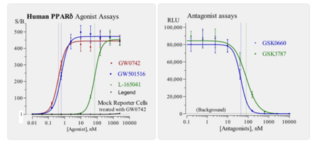
- Screen test samples to quantify functional activity, either agonist or antagonist, that they may exert against human PPARδ
- Robust technology provides sustained response for consistent and reproducible data acquistion
- Included in kit: Ready-to-use, pre-transfected reporter cells | Optimized media | Reference agonist | Luciferase detection reagent | Cell culture ready assay plate
Technical Support & Resources
Visit our FAQ
Contact Us
Toll Free Phone (USA and Canada Only): (888) 526-5351
Direct Phone: (734) 975-3888
Product Categories
Product Type
Application
Human Peroxisome Proliferator-Activated Receptor Beta/Delta Reporter Assay System
Item No. 15731
Technical Information
- NR1C2
- PPARD
- PPARδ/PPARβ
Shipping & Storage Information
Recommended Products
Certificates of Analysis & Batch Specific Data
Provide batch numbers separated by commas to download or request available product inserts, QC sheets, certificates of analysis, data packs, and GC-MS data.


Explore Obesity & Metabolic Disease Resources
Discover high-quality research tools to investigate GLP-1 mechanisms and next-generation metabolic targets.
OBESITY RESEARCH SOLUTIONSProduct Description
These PPARδ Reporter Assay Systems utilize non-human mammalian cells engineered to express human PPARδ.
Peroxisome proliferator-activated receptor delta (PPARδ or PPARβ), also known as NR1C2 is a nuclear receptor encoded by the PPARδ gene. This protein is a potential inhibitor of ligand-induced transcription activity of PPARα and PPARγ. It may function as an integrator of transcription repression and nuclear receptor signaling. The expression of PPARδ gene is found to be elevated in colorectal cancer cells. The elevated expression can be repressed by adenomatosis polyposis coli (APC), a tumor suppressor protein involved in the APC/beta-catenin signaling pathway. Knockout studies in mice suggested the role of PPARδ in myelination of the corpus callosum, epidermal cell proliferation, and glucose and lipid metabolism. PPARδ has been shown to be involved in differentiation, lipid accumulation, directional sensing, polarization, and migration in keratinocytes.
PPAR Reporter Cells are prepared using INDIGO’s proprietary CryoMite™ process. This cryo-preservation method yields high cell viability post-thaw, and provides the convenience of immediately dispensing healthy, division-competent reporter cells into assay plates. There is no need for intermediate spin-and-wash steps, viability determinations, or cell titer adjustments.[INDIGO Catalog Nos. IB00121-32, IB00121, IB00122]
WARNING This product is not for human or veterinary use.
Contact Info
Cayman Chemical1180 East Ellsworth RoadAnn Arbor, Michigan 48108 USAToll Free: (800) 364-9897(USA and Canada only)Fax: (734) 971-3640


