
Features
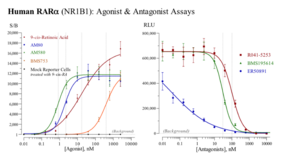
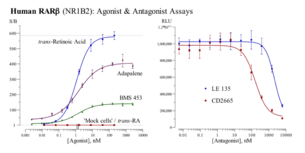
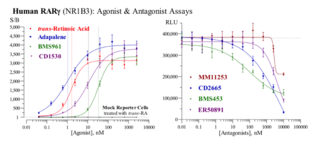
- Screen test samples to quantify functional activity, either agonist or antagonist, that they may exert against human RARγ, RARβ, or RARα
- Robust technology provides sustained response for consistent and reproducible data acquistion
- Included in kit: 3 vials of ready-to-use, pre-transfected reporter cells for RARα, RARβ, and RARγ | Optimized media | 2 x reference agonists - 9-cis-retinoic acid and trans-retinoic acid | Luciferase detection reagent |
Technical Support & Resources
Visit our FAQ
Contact Us
Toll Free Phone (USA and Canada Only): (888) 526-5351
Direct Phone: (734) 975-3888
Product Categories
Product Type
Application
Technical Information
- RARα
- RARβ
- RARγ
Shipping & Storage Information
Recommended Products
Certificates of Analysis & Batch Specific Data
Provide batch numbers separated by commas to download or request available product inserts, QC sheets, certificates of analysis, data packs, and GC-MS data.


Explore Obesity & Metabolic Disease Resources
Discover high-quality research tools to investigate GLP-1 mechanisms and next-generation metabolic targets.
OBESITY RESEARCH SOLUTIONSProduct Description
This PANEL of Retinoic Acid Receptors Reporter Assays utilizes non-human mammalian cells engineered to express distinct human RARα (NR1B1), RARβ (NR1B2), and RARγ (NR1B3) proteins. Retinoic acid receptors (RARs) are nuclear hormone receptors of the NRB1 class, which function as heterodimers with retinoid X receptors (RXRs). There are three distinct RAR subtypes; RARalpha, RARbeta and RARgamma. RARalpha is present in most tissue types, whereas RARbeta and RARgamma expression is more selective. RXR-RAR heterodimers act as ligand-dependent transcriptional regulators by binding to the specific retinoic acid response element (RARE) found in the promoter regions of target genes. In the absence of an RAR agonist, RXR-RAR recruits co-repressor proteins such as NCoR and associated factors such as histone deacetylase to maintain a condensed chromatin structure. RAR agonist binding stimulates co-repressor release and co-activator complexes, such as histone acetyltransferase, are recruited to activate transcription. RARs transduce retinoid signals in vivo, which mediates proper embryogenesis, differentiation and growth arrest. Specifically, RXRalpha-RARgamma heterodimers are necessary for growth arrest and viseral and primitive endodermal differentiation, whereas RXRalpha-RARalpha is required for cAMP-dependent parietal endodermal differentiation. In vitro it has been difficult to elucidate the roles of individual subtypes as functional RAR knockouts generate artificial redundancies that are thought not to exist under normal conditions. RAR Reporter Cells are prepared using INDIGO’s proprietary CryoMite™ process. This cryo-preservation method yields high cell viability post-thaw, and provides the convenience of immediately dispensing healthy, division-competent reporter cells into assay plates. There is no need for intermediate spin-and-wash steps, viability determinations, or cell titer adjustments.[INDIGO Catalog No. IB02301-48P]
WARNING This product is not for human or veterinary use.
Contact Info
Cayman Chemical1180 East Ellsworth RoadAnn Arbor, Michigan 48108 USAToll Free: (800) 364-9897(USA and Canada only)Fax: (734) 971-3640


