Technical Support & Resources
Information provided in the product description is from published literature. Due to the nature of scientific experimentation, your results (e.g., selectivity and effective concentrations) or specific application for this product may differ. If you have questions about how this product fits your application, please contact our technical support staff.
Visit our FAQ
Contact Us
Toll Free Phone (USA and Canada Only): (888) 526-5351
Direct Phone: (734) 975-3888
Product Categories
Research Area
Technical Information
Shipping & Storage Information
Recommended Products
Certificates of Analysis & Batch Specific Data
Provide batch numbers separated by commas to download or request available product inserts, QC sheets, certificates of analysis, data packs, and GC-MS data.

Visit Our Cancer Resource Center
Find Tools & Resources to Study the Hallmarks of Cancer
- Cancer cell signaling & regulation
- Cancer metabolism
- Tumor microenvironment
Product Description
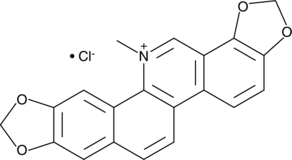
Sanguinarine is a benzylisoquinoline alkaloid isolated from plants belonging to the family Papaveraceae.1 It exhibits antimicrobial, anti-inflammatory, and anti-oxidant properties and demonstrates antiproliferative and pro-apoptotic effects in some cancer cell lines. Sanguinarine suppresses NF-κB activation by blocking the degradation of IκBα and sensitizes cancer cells to apoptosis by inducing ROS generation and activating TNF-related apoptosis-inducing ligand.2 Furthermore, sanguinarine has been shown to reduce cancer cell metastasis though the inhibition of MMP-2 and MMP-9 activation and to exhibit antiangiogenic activity by downregulating VEGF-induced Akt activation.2
WARNING This product is not for human or veterinary use.
References & Product Citations
1. Alkaloid biosynthesis: Metabolism and trafficking. Annu. Rev. Plant Biol. 59, 735-769 (2008).
2. Regulation of survival, proliferation, invasion, angiogenesis, and metastasis of tumor cells through modulation of inflammatory pathways by nutraceuticals. Cancer Metastasis Rev. 29(3), 405-434 (2010).
Contact Info
Cayman Chemical1180 East Ellsworth RoadAnn Arbor, Michigan 48108 USAToll Free: (800) 364-9897(USA and Canada only)Fax: (734) 971-3640