
Technical Support & Resources
Visit our FAQ
Contact Us
Toll Free Phone (USA and Canada Only): (888) 526-5351
Direct Phone: (734) 975-3888
Product Categories
Technical Information
Shipping & Storage Information
Recommended Products
Certificates of Analysis & Batch Specific Data
Provide batch numbers separated by commas to download or request available product inserts, QC sheets, certificates of analysis, data packs, and GC-MS data.
Product Description
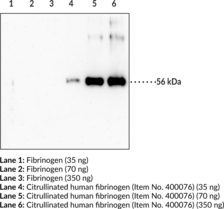
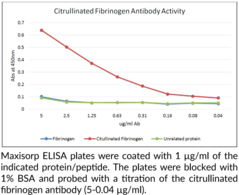
Fibrinogen is a hexameric glycoprotein that has roles in coagulation and hemostasis.1,2 It is comprised of two sets of Aα, Bβ, and γ polypeptide chains encoded by FGA, FGB, and FGG, respectively, in humans.1 Fibrinogen is synthesized in hepatocytes and secreted into the plasma. Following thrombin-mediated cleavage of N-terminal fibrinopeptides from the Aα and Bβ chains, yielding the α and β chains, respectively, fibrinogen assembles into fibrin protofibrils and then mature fibers, which provide structure and viscoelasticity to blood clots.2,3,4 Mutations in FGA, FGB, or FGG have been found in patients with afibrinogenemia or hypofibrinogenemia.1 Elevated plasma fibrinogen levels are associated with an increased risk of cardiovascular disease.5 Fibrinogen can be citrullinated by protein arginine deiminase 2 (PAD2) and PAD4.6 Immune complexes containing citrullinated fibrinogen have been found in patients with anti-citrullinated protein antibody-positive rheumatoid arthritis.7 Cayman’s Citrullinated Fibrinogen Monoclonal Antibody (Clone 10E9.3) can be used for ELISA and Western blot (WB) applications. The antibody recognizes citrullinated fibrinogen at 56 kDa from human samples.
WARNING This product is not for human or veterinary use.
References & Product Citations
1. Congenital fibrinogen disorders: An update. Semin. Thromb. Hemost. 39(6), 585-595 (2013).
2. Fibrinogen and fibrin: An illustrated review. Res. Pract. Thromb. Haemost. 3(2), 161-172 (2019).
3. Fibrinogen and fibrin structure and functions. J. Thromb. Haemost. 3(8), 1894-1904 (2005).
4. Fibrin formation, structure and properties. Subcell. Biochem. 82, 405-456 (2017).
5. Fibrinogen: Biochemistry, epidemiology and determinants. Q. J. M. 96(10), 711-729 (2003).
6. Demonstration of extracellular peptidylarginine deiminase (PAD) activity in synovial fluid of patients with rheumatoid arthritis using a novel assay for citrullination of fibrinogen. Arthritis Res. Ther. 16(6), 498 (2014).
7. Immune complexes containing citrullinated fibrinogen costimulate macrophages via toll-
Contact Info
Cayman Chemical1180 East Ellsworth RoadAnn Arbor, Michigan 48108 USAToll Free: (800) 364-9897(USA and Canada only)Fax: (734) 971-3640


