
Technical Support & Resources
Information provided in the product description is from published literature. Due to the nature of scientific experimentation, your results (e.g., selectivity and effective concentrations) or specific application for this product may differ. If you have questions about how this product fits your application, please contact our technical support staff.
Visit our FAQ
Contact Us
Toll Free Phone (USA and Canada Only): (888) 526-5351
Direct Phone: (734) 975-3888

Technical Information
Shipping & Storage Information
Recommended Products
Certificates of Analysis & Batch Specific Data
Provide batch numbers separated by commas to download or request available product inserts, QC sheets, certificates of analysis, data packs, and GC-MS data.
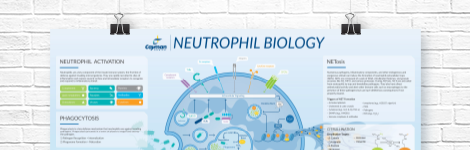
Neutrophil Biology Wall Poster
Explore how neutrophils shape the immune response in health and disease. This poster highlights neutrophil pathogen defense mechanisms, including phagocytosis, degranulation, and NETosis, as well as neutrophil roles in inflammation and NET-associated pathologies.
DOWNLOAD NOWProduct Description
Lysine-specific demethylase 1 (LSD1) is a protein lysine demethylase that specifically demethylates histone H3 lysine 4 (H3K4) and H3K9, resulting in transcriptional repression.1 Host LSD1 is also recruited by certain viruses to limit H3K9 methylation, which can repress viral genes necessary for infection.2 OG-L002 is a potent inhibitor of LSD1 (IC50 = 0.02 µM) that less effectively inhibits the monoamine oxidases A (MAO-A) and MAO-B (IC50s = 1.38 and 0.72 µM).2 It blocks the expression of immediate early (IE) genes of herpes simplex virus (HSV) in HeLa cells but not that of cellular control genes.2 OG-L002 also reduces the expression of human cytomegalovirus IE genes and adenovirus E1A gene in mammalian cells.2 It is effective in vivo, repressing HSV primary infection in mice and blocking HSV reactivation from latency in a mouse ganglion explant model.2
WARNING This product is not for human or veterinary use.
References & Product Citations
1. Human histone demethylase LSD1 reads the histone code. The Journal of Biological Chemisty 280(50), 41360-41365 (2005).
2. A novel selective LSD1/KDM1A inhibitor epigenetically blocks Herpes simplex virus lytic replication and reactivation from latency. mBio 4(1), 1-9 (2013).
Contact Info
Cayman Chemical1180 East Ellsworth RoadAnn Arbor, Michigan 48108 USAToll Free: (800) 364-9897(USA and Canada only)Fax: (734) 971-3640


