
Technical Support & Resources
Visit our FAQ
Contact Us
Toll Free Phone (USA and Canada Only): (888) 526-5351
Direct Phone: (734) 975-3888
Product Categories
STING Monoclonal Antibody (Clone 2C8)
Item No. 17856
Technical Information
- Endoplasmic Reticulum Interferon Stimulator
- ERIS
- Mediator of IRF3 Activation
- MITA
- MPYS
- Stimulator of Interferon Genes
- TMEM173
- Transmembrane Protein 173
Shipping & Storage Information
Recommended Products
Certificates of Analysis & Batch Specific Data
Provide batch numbers separated by commas to download or request available product inserts, QC sheets, certificates of analysis, data packs, and GC-MS data.

Visit Our Cancer Resource Center
Find Tools & Resources to Study the Hallmarks of Cancer
- Cancer cell signaling & regulation
- Cancer metabolism
- Tumor microenvironment
Product Description
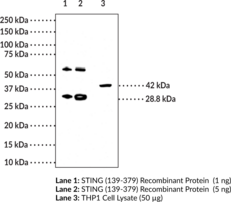
Stimulator of Interferon Genes (STING) is a component of the innate immune response. STING binds to cyclic dinucleotides, which are bacterial second messengers.1 Recognition of cyclic-di-GMP (c-di-GMP), c-di-AMP, or c-GMP-AMP leads to activation of NF-κB and transcription of immunomodulatory genes, including type I interferon (IFN).2,3,4 Loss of STING regulation contributes to autoimmune disorders through increased IFN activity.5 The gene for STING is mutated in the mouse strain Goldenticket, which consequently lacks a type I IFN response to Listeria infection.6 Activation of STING by the flavonoid 5,6-dimethylxanthenone-4-acetic acid (DMXAA; Item No. 14617) has been shown to kill solid tumors in mice, but the binding site of DMXAA is not conserved in human STING.7,8 Cayman’s STING Monoclonal Antibody (Clone 2C8) can be used for ELISA, immunohistochemistry, and Western blot applications. The antibody recognizes STING at 42 kDa from human samples.
WARNING This product is not for human or veterinary use.
References & Product Citations
1. STING is a direct innate immune sensor of cyclic-
2. Cyclic GMP-
3. Cyclic GMP-
4. Cyclic dinucleotides trigger ULK1 (ATG1) phosphorylation of STING to prevent sustained innate immune signaling. Cell 155(3), 688-698 (2013).
5. Autoimmunity initiates in non-
6. The N-
7. Anticancer flavonoids are mouse-
8. Structure-
Contact Info
Cayman Chemical1180 East Ellsworth RoadAnn Arbor, Michigan 48108 USAToll Free: (800) 364-9897(USA and Canada only)Fax: (734) 971-3640


