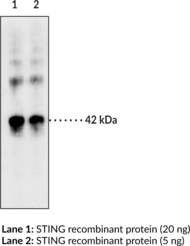
For immunochemical detection of STING
Related Products
Technical Support & Resources

Visit our FAQ

Contact Us

Toll Free Phone (USA and Canada Only): (888) 526-5351
Direct Phone: (734) 975-3888

Request Technical Support

Technical Support Request

To streamline the process attach the appropriate questionnaire to your inquiry.

Download IHC QuestionnaireDownload WB Questionnaire

View Our Privacy Statement for details on how we use and protect your data. In addition, this site is protected by hCaptcha and its Privacy Policy and Terms of Service apply.

STING Polyclonal Antibody

Item No. 17857

Technical Information
Synonyms
  • Endoplasmic Reticulum Interferon Stimulator
  • ERIS
  • Mediator of IRF3 Activation
  • MITA
  • MPYS
  • Stimulator of Interferon Genes
  • TMEM173
  • Transmembrane Protein 173
Immunogen
Human recombinant STING (Item No. 15139)
250 µg of Protein A-purified polyclonal antibody
Storage Buffer
TBS, pH 7.4, with 50% glycerol, 0.1% BSA, and 0.02% sodium azide
Host
Rabbit
Applications
ELISA, IP, and WB
Species Reactivity
(+) Human
Shipping & Storage Information
Storage
-20°C
Shipping
Wet ice in continental US; may vary elsewhere
Recommended Products

Certificates of Analysis & Batch Specific Data

Provide batch numbers separated by commas to download or request available product inserts, QC sheets, certificates of analysis, data packs, and GC-MS data.

    Add

    Cayman Chemical
    Visit Our Cancer Resource Center
    Find Tools & Resources to Study the Hallmarks of Cancer
    • Cancer cell signaling & regulation
    • Cancer metabolism
    • Tumor microenvironment
    EXPLORE NOW
    Product Description

    Stimulator of Interferon Genes (STING) is a component of the innate immune response. STING binds to cyclic dinucleotides, which are bacterial second messengers.1 Recognition of cyclic-di-GMP (c-di-GMP), c-di-AMP, or c-GMP-AMP leads to activation of NF-κB and transcription of immunomodulatory genes, including type I interferon (IFN).2,3,4 Loss of STING regulation contributes to autoimmune disorders through increased IFN activity.5 The gene for STING is mutated in the mouse strain Goldenticket, which consequently lacks a type I IFN response to Listeria infection.6 Activation of STING by the flavonoid 5,6-dimethylxanthenone-4-acetic acid (DMXAA; Item No. 14617) has been shown to kill solid tumors in mice, but the binding site of DMXAA is not conserved in human STING.7,8

    WARNING This product is not for human or veterinary use.

    References & Product Citations
    Product Description References

    1. Burdette, D.L., Monroe, K.M., Sotelo-Troha, K., et alSTING is a direct innate immune sensor of cyclic-di-GMP. Nature 478(7370), 515-518 (2011).

    2. Sun, L., Wu, J., Du, F., et alCyclic GMP-AMP synthase is a cytosolic DNA sensor that activates the type I interferon pathway. Science 339(6121), 786-791 (2013).

    3. Wu, J., Sun, L., Chen, X., et alCyclic GMP-AMP is an endogenous second messenger in innate immune signaling by cytosolic DNA. Science 339(6121), 826-830 (2013).

    4. Konno, H., Konno, K., and Barber, G.N. Cyclic dinucleotides trigger ULK1 (ATG1) phosphorylation of STING to prevent sustained innate immune signaling. Cell 155(3), 688-698 (2013).

    5. Gall, A., Treuting, P., Elkon, K.B., et alAutoimmunity initiates in non-hematopoietic cells and progresses via lymphocytes in an interferon-dependent autoimmune disease. Immunity 36(1), 120-131 (2012).

    6. Sauer, J.D., Sotelo-Troha, K., von Moltke, J., et alThe N-ethyl-N-nitrosourea-induced Goldenticket mouse mutant reveals an essential function of Sting in the in vivo interferon response to Listeria monocytogenes and cyclic dinucleotides. Infect. Immun. 79(2), 688-694 (2011).

    7. Kim, S., Li, L., Maliga, Z., et alAnticancer flavonoids are mouse-selective STING agonists. ACS Chem. Biol. 8(7), 1396-1401 (2013).

    8. Gao, P., Ascano, M., Zillinger, T., et alStructure-function analysis of STING activation by c[G(2',5')pA(3',5')p] and targeting by antiviral DMXAA. Cell 154(4), 748-762 (2013).