
Technical Support & Resources
Information provided in the product description is from published literature. Due to the nature of scientific experimentation, your results (e.g., selectivity and effective concentrations) or specific application for this product may differ. If you have questions about how this product fits your application, please contact our technical support staff.
Visit our FAQ
Contact Us
Toll Free Phone (USA and Canada Only): (888) 526-5351
Direct Phone: (734) 975-3888
Product Categories
Research Area

Technical Information
- NSC 637086
- Oxpentifylline
Shipping & Storage Information
Recommended Products
Certificates of Analysis & Batch Specific Data
Provide batch numbers separated by commas to download or request available product inserts, QC sheets, certificates of analysis, data packs, and GC-MS data.
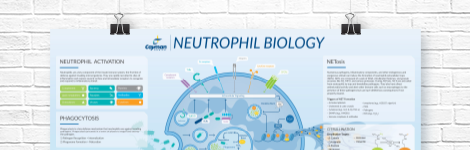
Neutrophil Biology Wall Poster
Explore how neutrophils shape the immune response in health and disease. This poster highlights neutrophil pathogen defense mechanisms, including phagocytosis, degranulation, and NETosis, as well as neutrophil roles in inflammation and NET-associated pathologies.
DOWNLOAD NOWProduct Description
Pentoxifylline is a methylxanthine derivative. It has been shown to have anti-inflammatory activity, inhibiting LPS-induced TNF-α production in isolated peripheral blood mononuclear cells (IC50 = 85 µM) and suppressing LPS-induced leukopenia in mice.1 Pentoxifylline weakly inhibits the generation of phosphatidic acid (IC50 = 500 µM) from LPS-activated lysophosphatidic acyl transferase (LPAAT), and weakly antagonizes A1 and A2 adenosine receptors.2,3 It also inhibits human acidic mammalian chitinase, human chitotriosidase, and chitinase B1 from Aspergillus fumigatus (IC50s = 49, 98, and 126 µM, respectively).4
WARNING This product is not for human or veterinary use.
References & Product Citations
1. Substituted xanthines, pteridinediones, and related compounds as potential antiinflammatory agents. Synthesis and biological evaluation of inhibitors of tumor necrosis factor α. J. Med. Chem. 39, 2-9 (1996).
2. Protection from endotoxic shock in mice by pharmacologic inhibition of phosphatidic acid. Proc. Natl. Acad. Sci. USA 91(9), 3857-3861 (1994).
3. Xanthine derivatives as antagonists at A1 and A2 adenosine receptors. Naunyn Schmiedebergs Arch. Pharmacol. 330(3), 212-221 (1985).
4. Methylxanthine drugs are chitinase inhibitors: Investigation of inhibition and binding modes. Chem. Biol. 12(9), 973-980 (2005).
Contact Info
Cayman Chemical1180 East Ellsworth RoadAnn Arbor, Michigan 48108 USAToll Free: (800) 364-9897(USA and Canada only)Fax: (734) 971-3640


