
Technical Support & Resources
Visit our FAQ
Contact Us
Toll Free Phone (USA and Canada Only): (888) 526-5351
Direct Phone: (734) 975-3888
Product Categories
Technical Information
- NARC-1
- Proprotein Convertase Subtilisin Kexin 9
Shipping & Storage Information
Recommended Products
Certificates of Analysis & Batch Specific Data
Provide batch numbers separated by commas to download or request available product inserts, QC sheets, certificates of analysis, data packs, and GC-MS data.

Explore Obesity & Metabolic Disease Resources
Discover high-quality research tools to investigate GLP-1 mechanisms and next-generation metabolic targets.
OBESITY RESEARCH SOLUTIONSProduct Description
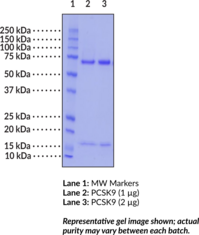
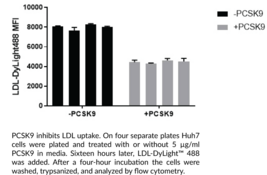
Proprotein convertase subtilisin kexin 9 (PCSK9) is a zymogen and member of the subtilisin serine protease family that reduces protein levels of LDL receptors (LDLRs), the receptor for LDL-cholesterol (LDL-C).1,2 It is primarily expressed in the liver and is composed of an N-terminal prodomain that regulates PCSK9 maturation, a catalytic domain containing a catalytic aspartic acid-histidine-serine triad, and a C-terminal domain that contains the LDLR binding site.3,4,2 PCSK9 is synthesized as a proprotein that is autocatalytically cleaved to generate the 63 kDa mature protein in which the N-terminal prodomain remains non-covalently bound to the catalytic domain to inhibit further activity.4 The mature PCSK9 is secreted and circulates in the plasma where it binds to cell surface-expressed LDLRs, triggering endocytosis and lysosomal degradation of the PCSK9-LDLR complex.2 This action decreases LDLR expression and reduces cellular LDL-C uptake. Gain-of-function and loss-of-function PCSK9 mutations have been associated with autosomal dominant hypercholesterolemia and decreased plasma LDL-C levels, respectively, in humans.2 Reducing the activity of circulating PCSK9 with monoclonal antibodies or small molecule inhibitors decreases LDL-C levels and reduces the risk of adverse cardiovascular events in individuals with hypercholesterolemia. Cayman's PCSK9 (human, recombinant) protein is synthesized as a 76 kDa proprotein. After cleavage of the signal peptide PCKS9 autocatalytically cleaves to the ~15 kDa prodomain and the ~60 kDa mature form and can be used for ELISA, flow cytometry (FC), and Western blot (WB) applications.
WARNING This product is not for human or veterinary use.
References & Product Citations
1. Overexpression of PCSK9 accelerates the degradation of the LDLR in a post-
2. Molecular and cellular function of the proprotein convertase subtilisin/kexin type 9 (PCSK9). Basic Res. Cardiol. 110(2), 4 (2015).
3. The secretory proprotein convertase neural apoptosis-
4. PCSK9: Regulation and target for drug development for dyslipidemia. Annu. Rev. Pharmacol. Toxicol. 57, 223-244 (2017).
Contact Info
Cayman Chemical1180 East Ellsworth RoadAnn Arbor, Michigan 48108 USAToll Free: (800) 364-9897(USA and Canada only)Fax: (734) 971-3640


