
Technical Support & Resources
Information provided in the product description is from published literature. Due to the nature of scientific experimentation, your results (e.g., selectivity and effective concentrations) or specific application for this product may differ. If you have questions about how this product fits your application, please contact our technical support staff.
Visit our FAQ
Contact Us
Toll Free Phone (USA and Canada Only): (888) 526-5351
Direct Phone: (734) 975-3888
Product Categories
Research Area
Technical Information
Shipping & Storage Information
Recommended Products
Certificates of Analysis & Batch Specific Data
Provide batch numbers separated by commas to download or request available product inserts, QC sheets, certificates of analysis, data packs, and GC-MS data.
Product Description
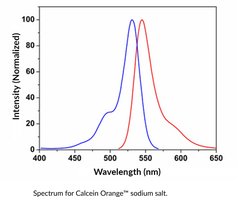
Calcein Orange™ is a membrane-impermeant fluorescent dye. It is an orange-emitting variant of the green fluorophore Calcein (Item No. 16221), which has been entrapped in liposomes and similar vesicles for studying membrane characteristics.1,2 Calcein Orange™ displays excitation/emission maxima of 525/550 nm, respectively.
WARNING This product is not for human or veterinary use.
References & Product Citations
1. Photo activation of HPPH encapsulated in "Pocket" liposomes triggers multiple drug release and tumor cell killing in mouse breast cancer xenografts. Int. J. Nanomedicine 10, 125-145 (2014).
2. Membrane disintegration caused by the steroid saponin digitonin is related to the presence of cholesterol. Molecules 20(11), 20146-20160 (2015).
Contact Info
Cayman Chemical1180 East Ellsworth RoadAnn Arbor, Michigan 48108 USAToll Free: (800) 364-9897(USA and Canada only)Fax: (734) 971-3640


