
Technical Support & Resources
Visit our FAQ
Contact Us
Toll Free Phone (USA and Canada Only): (888) 526-5351
Direct Phone: (734) 975-3888
Product Categories

Technical Information
- H3pS10
- H3pSer10
- Histone H3 (Phospho-Ser10)
- Phospho-Histone H3 Serine 10
- Phosphorylated Histone H3 Serine 10
Shipping & Storage Information
Recommended Products
Certificates of Analysis & Batch Specific Data
Provide batch numbers separated by commas to download or request available product inserts, QC sheets, certificates of analysis, data packs, and GC-MS data.

Visit Our Cancer Resource Center
Find Tools & Resources to Study the Hallmarks of Cancer
- Cancer cell signaling & regulation
- Cancer metabolism
- Tumor microenvironment
Product Description
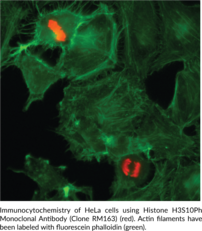
Histone H3 is a nuclear protein and a component of the nucleosome core, a basic unit of chromatin, that is essential for organizing genomic DNA in eukaryotic nuclei.1 It is a globular protein that contains an unstructured N-terminal tail that extends outside of the nucleosome core and is subject to various post-translational modifications (PTMs), including methylation, phosphorylation, acetylation, and citrullination.1,2 Phosphorylation of histone H3 at serine 10 (H3S10Ph) is correlated with chromatin condensation during mitosis and with transcriptional activation of genes during interphase.3,4 H3S10Ph does not inhibit binding of the ADD domain of the chromatin-remodeling protein ATRX to histone H3 N-terminal peptides due to its positioning away from the core peptide binding sequence but does decrease binding of the HP1α chromodomain (CD) when the histone H3 peptide is also trimethylated at lysine 9.5 Low median levels of H3S10Ph in tumor tissue isolated from patients with oral squamous cell carcinoma (OSCC) are associated with cervical lymph node metastasis.6 Cayman's Histone H3S10Ph Monoclonal Antibody (Clone RM163) can be used for ELISA, immunocytochemistry (ICC), multiplex-based assay, and Western blot (WB) applications.
WARNING This product is not for human or veterinary use.
References & Product Citations
1. Writing, erasing and reading histone lysine methylations. Exp. Mol. Med. 49(4), e324 (2017).
2. Histone posttranslational modifications: Potential role in diagnosis, prognosis, and therapeutics of cancer. Prognostic Epigenetics 15, 351-373 (2019).
3. Histone H3 phosphorylation -
4. Phosphorylation of serine 10 in histone H3, what for? J. Cell. Sci. 116(Pt. 18), 3677-3685 (2003).
5. ATRX tolerates activity-
6. Prognostic value of histone H3 serine 10 phosphorylation and histone H4 lysine 12 acetylation in oral squamous cell carcinoma. Histopathology 74(2), 227-238 (2019).
Contact Info
Cayman Chemical1180 East Ellsworth RoadAnn Arbor, Michigan 48108 USAToll Free: (800) 364-9897(USA and Canada only)Fax: (734) 971-3640


