
Technical Support & Resources
Information provided in the product description is from published literature. Due to the nature of scientific experimentation, your results (e.g., selectivity and effective concentrations) or specific application for this product may differ. If you have questions about how this product fits your application, please contact our technical support staff.
Visit our FAQ
Contact Us
Toll Free Phone (USA and Canada Only): (888) 526-5351
Direct Phone: (734) 975-3888
Technical Information
- Ro 4-4393
Shipping & Storage Information
Recommended Products
Certificates of Analysis & Batch Specific Data
Provide batch numbers separated by commas to download or request available product inserts, QC sheets, certificates of analysis, data packs, and GC-MS data.

Neutrophil Biology Wall Poster
Explore how neutrophils shape the immune response in health and disease. This poster highlights neutrophil pathogen defense mechanisms, including phagocytosis, degranulation, and NETosis, as well as neutrophil roles in inflammation and NET-associated pathologies.
DOWNLOAD NOWProduct Description
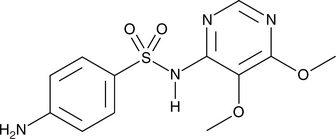
Sulfadoxin is a sulfonamide antibiotic that inhibits dihydropteroate synthetase (DHPS), an enzyme involved in folic acid (Item No. 20515) synthesis.1 Sulfadoxin competes with 4-aminobenzoate (PABA), the native substrate of DHPS, and inhibits PABA incorporation into folic acid.2 Folate is essential for purine and pyrimidine synthesis, therefore, sulfadoxin has antiproliferative activity in non-resistant P. falciparum.2,3 Sulfadoxin inhibits growth of P. falciparum in vitro, but potency varies between non-resistant (IC50 = 4 ng/ml) and resistant strains (IC50 = 3,970 ng/ml).3
WARNING This product is not for human or veterinary use.
References & Product Citations
1. Sequence variation of the hydroxymethyldihydropterin pyrophosphokinase: dihydropteroate synthase gene in lines of the human malaria parasite, Plasmodium falciparum, with differing resistance to sulfadoxine. Eur. J. Biochem. 224(2), 397-405 (1994).
2. Exploring the folate pathway in Plasmodium falciparum. Acta. Trop. 94(3), 191-206 (2005).
3. Sulfadoxine resistance in the human malaria parasite Plasmodium falciparum is determined by mutations in dihydropteroate synthetase and an additional factor associated with folate utilization. Mol. Microbiol. 23(5), 979-986 (1997).
Contact Info
Cayman Chemical1180 East Ellsworth RoadAnn Arbor, Michigan 48108 USAToll Free: (800) 364-9897(USA and Canada only)Fax: (734) 971-3640


