
Technical Support & Resources
Visit our FAQ
Contact Us
Toll Free Phone (USA and Canada Only): (888) 526-5351
Direct Phone: (734) 975-3888
Product Categories
Product Type
Technical Information
- Chaperonin 60
- Cpn60
- Heat Shock Protein 60
- HSPD1
- Mitochondrial Matrix Protein P1
Shipping & Storage Information
Recommended Products
Certificates of Analysis & Batch Specific Data
Provide batch numbers separated by commas to download or request available product inserts, QC sheets, certificates of analysis, data packs, and GC-MS data.

Explore Obesity & Metabolic Disease Resources
Discover high-quality research tools to investigate GLP-1 mechanisms and next-generation metabolic targets.
OBESITY RESEARCH SOLUTIONSProduct Description
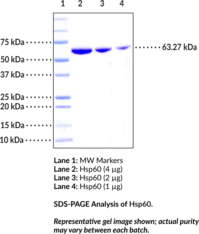
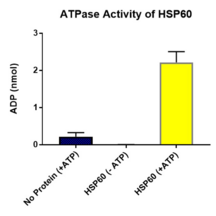
Heat shock protein 60 (Hsp60), also known as heat shock protein family D member 1 (HspD1), is an approximately 60 kDa protein that functions as a molecular chaperone.1 It belongs to the type I subclass of chaperonins and is found in eubacteria, mitochondria, and chloroplasts where its expression is induced by stress. Hsp60 primarily exists as a heptameric ring that it is converted to a tetradecameric double-ring structure in the presence of ATP.2 Within mitochondria, it associates with its co-chaperone, Hsp10, to form a barrel-like structure and refold proteins that have been shuttled to the mitochondria in an ATP-dependent manner.2,3 Hsp60 also has extramitochondrial functions such as the production of proinflammatory cytokines in human leukocytes and activation of innate immune receptors.4,5 Hsp60 expression is increased in the serum and saliva of patients with type 2 diabetes mellitus and mutations in HSPD1 lead to neurodegenerative diseases.5,6
WARNING This product is not for human or veterinary use.
References & Product Citations
1. Type I chaperonins: Not all are created equal. FEBES Lett. 529(1), 1-5 (2002).
2. HSP60 possesses a GTPase activity and mediates protein folding with HSP10. Sci. Rep. 7(1), 16931 (2017).
3. Crystallization and structure determination of a symmetrical “football” complex of the mammalian mitochondrial Hsp60-
4. Lipopolysaccharide-
5. Does Hsp60 Provide a Link between Mitochondrial Stress and Inflammation in Diabetes Mellitus? J. Diabetes Res. 2016:8017571, (2016).
6. Disease-
Contact Info
Cayman Chemical1180 East Ellsworth RoadAnn Arbor, Michigan 48108 USAToll Free: (800) 364-9897(USA and Canada only)Fax: (734) 971-3640


