
Technical Support & Resources
Visit our FAQ
Contact Us
Toll Free Phone (USA and Canada Only): (888) 526-5351
Direct Phone: (734) 975-3888
Product Categories
Technical Information
- NAK
- NF-κB-Activating Kinase
- TANK-Binding Kinase 1
Shipping & Storage Information
Recommended Products
Certificates of Analysis & Batch Specific Data
Provide batch numbers separated by commas to download or request available product inserts, QC sheets, certificates of analysis, data packs, and GC-MS data.
Kinase Resource Center
Discover Products & Resources for Kinase Research
- Kinase inhibitors, screening libraries, assay kits, & more
- Tools to study kinase signaling pathways:
- Growth factor signaling
- PI3K/Akt/mTOR
- MAPKs (ERK, p38, & JNK)
- JAK/STAT signaling
- Articles, resources, & advice
Product Description
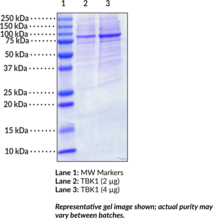
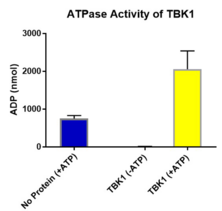
TANK-binding kinase 1 (TBK1) is a non-canonical inhibitor of NF-κB kinase (IKK) that has an essential role in regulating inflammatory responses to pathogens.1 Following activation of toll-like receptors by viral DNA, TBK1 interacts with various partners such as STING, MAVS, and TANK to phosphorylate and activate interferon regulatory factors (IRFs) 3 and 7 as well as DEAD-box helicase 3 X-linked (DDX3X), which leads to transcriptional activation of pro-inflammatory and antiviral genes including interferon (IFN) subtypes α and β.1,2 TBK1 induces nuclear translocation of NF-κB to initiate a pro-inflammatory response via phosphorylation of NF-κB inhibitor α (NFκBIα), IKKβ, or NF-κB p65 subunit (RelA).3 Cytosolic localization of E. coli, Salmonella, and S. pyogenes increases in TBK1-/- murine embryonic fibroblasts, macrophages, and epithelial cells, suggesting TBK1 maintains vacuolar integrity, which is critical to bacterial clearance.4 TBK1 phosphorylates the autophagy receptor optineurin to enhance binding of ubiquitin-like microtubule-associated protein light chain 3 (LC3) modifiers and induce autophagic clearance of S. enterica.5 It also binds to severe acute respiratory syndrome coronavirus 2 (SARS-CoV-2) non-structural protein 13 (Nsp13), a helicase-triphosphatase and a component of the viral replicase-transcriptase complex.6 Cayman’s TBK1 (human, recombinant) protein can be used for ELISA, Western blot and enzymatic assays.
WARNING This product is not for human or veterinary use.
References & Product Citations
1. NF-
2. STING specifies IRF3 phosphorylation by TBK1 in the cytosolic DNA signaling pathway. Sci. Signal 5(214), ra20 (2012).
3. NAK is an IkB kinase-
4. TBK1 protects vacuolar integrity during intracellular bacterial infection. PLoS Pathog. 3(3), e29 (2007).
5. Phosphorylation of the autophagy receptor optineurin restricts Salmonella growth. Science 333(6039), 228-233 (2011).
6. A SARS-
Contact Info
Cayman Chemical1180 East Ellsworth RoadAnn Arbor, Michigan 48108 USAToll Free: (800) 364-9897(USA and Canada only)Fax: (734) 971-3640


