
Technical Support & Resources
Visit our FAQ
Contact Us
Toll Free Phone (USA and Canada Only): (888) 526-5351
Direct Phone: (734) 975-3888
Product Categories
Product Type
Technical Information
- Glyoxal BSA
- Glyoxal-Bovine Serum Albumin
- GO-Bovine Serum Albumin
Shipping & Storage Information
Recommended Products
Certificates of Analysis & Batch Specific Data
Provide batch numbers separated by commas to download or request available product inserts, QC sheets, certificates of analysis, data packs, and GC-MS data.

Explore Obesity & Metabolic Disease Resources
Discover high-quality research tools to investigate GLP-1 mechanisms and next-generation metabolic targets.
OBESITY RESEARCH SOLUTIONSProduct Description
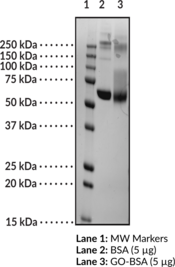
Advanced glycation end products (AGEs) are formed from the nonenzymatic reaction of amino groups with reducing sugars.1,2,3 AGEs have been implicated in diseases, such as diabetes mellitus, non-diabetic nephropathy, macrovascular disease, Alzheimer’s disease, cataract, and ageing.1,2,3 AGE receptors, such as the receptor for AGE (RAGE), mediate biological responses to AGEs, including endocytic uptake and degradation and induction of cytokines and growth factors.1,2,3 AGE-BSA (glyoxal modified) was produced by incubating BSA with glyoxal, followed by extensive dialysis.
WARNING This product is not for human or veterinary use.
References & Product Citations
1. Advanced glycation end-
2. Oxidative stress and diabetic complications. Circ. Res. 107(9), 1058-1070 (2010).
3. Advanced glycoxidation and lipoxidation end products (AGEs and ALEs): An overview of their mechanisms of formation. Free Radic. Res. 47(Suppl 1), 3-27 (2013).
Contact Info
Cayman Chemical1180 East Ellsworth RoadAnn Arbor, Michigan 48108 USAToll Free: (800) 364-9897(USA and Canada only)Fax: (734) 971-3640


