
Technical Support & Resources
Information provided in the product description is from published literature. Due to the nature of scientific experimentation, your results (e.g., selectivity and effective concentrations) or specific application for this product may differ. If you have questions about how this product fits your application, please contact our technical support staff.
Visit our FAQ
Contact Us
Toll Free Phone (USA and Canada Only): (888) 526-5351
Direct Phone: (734) 975-3888
Product Categories
Technical Information
- NSC 84989
- NSC 170950
Shipping & Storage Information
Recommended Products
Certificates of Analysis & Batch Specific Data
Provide batch numbers separated by commas to download or request available product inserts, QC sheets, certificates of analysis, data packs, and GC-MS data.
Product Description
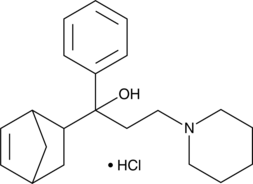
Biperiden is an antagonist of muscarinic acetylcholine receptors (mAChRs; IC50s = 0.48, 6.3, 3.9, 2.4, and 6.3 nM for M1-5 receptors, respectively).1 It increases spontaneous and electrically evoked dopamine release and electrically evoked acetylcholine (ACh) release from rabbit caudate nucleus slices preincubated with dopamine.2 Biperiden (10 µM) also inhibits NMDA-induced ACh release in rabbit caudate nucleus slices.3 Biperiden (0.01-1.0 mg/kg) reduces physostigmine-induced tremor in rats.4 Formulations containing biperiden have been used as an adjuvant treatment for Parkinson's disease.
WARNING This product is not for human or veterinary use.
References & Product Citations
1. Antagonism by antimuscarinic and neuroleptic compounds at the five cloned human muscarinic cholinergic receptors expressed in Chinese hamster ovary cells. J. Pharmacol. Exp. Ther. 260(2), 576-580 (1992).
2. Effects of the antiparkinsonian drug budipine on neurotransmitter release in central nervous system tissue in vitro. J. Pharmacol. Exp. Ther. 264(2), 889-898 (1993).
3. The antiparkinsonian drugs budipine and biperiden are use-
4. Drugs for Parkinson’s disease reduce tremor induced by physostigmine. Naunyn Schmiedebergs Arch. Pharmacol. 323(3), 205-210 (1983).
Contact Info
Cayman Chemical1180 East Ellsworth RoadAnn Arbor, Michigan 48108 USAToll Free: (800) 364-9897(USA and Canada only)Fax: (734) 971-3640


