
Technical Support & Resources
Information provided in the product description is from published literature. Due to the nature of scientific experimentation, your results (e.g., selectivity and effective concentrations) or specific application for this product may differ. If you have questions about how this product fits your application, please contact our technical support staff.
Visit our FAQ
Contact Us
Toll Free Phone (USA and Canada Only): (888) 526-5351
Direct Phone: (734) 975-3888
Product Categories
Product Type
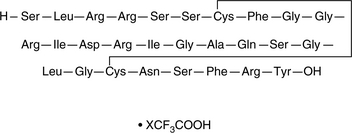
Atrial Natriuretic Peptide (1-28) (rat) (trifluoroacetate salt)
Item No. 24276
Technical Information
- ANF
- ANP
- Atrial Natriuretic Factor
- α-Atriopeptin (rat)
Shipping & Storage Information
Recommended Products
Certificates of Analysis & Batch Specific Data
Provide batch numbers separated by commas to download or request available product inserts, QC sheets, certificates of analysis, data packs, and GC-MS data.
Product Description
Atrial natriuretic peptide (ANP) is an endogenous peptide generated by proteolysis of prepro-ANP that is secreted by cardiomyocytes in the heart.1,2 It has effects on the renal and cardiovascular systems that decrease vasoconstriction, inhibit renin secretion, and increase sodium excretion. In rat kidney cortex ex vivo, exogenous rat ANP inhibits basal renin release in a dose-dependent manner and inhibits renin release induced by isoproterenol (Item No. 15592) with an IC50 value of 58 nM.3 ANP (8 µg/kg) decreases plasma renin activity and cAMP levels in anesthetized rats and increases cGMP levels. It also inhibits arginine vasopressin-induced increases in mean arterial blood pressure in spontaneously hypertensive and control rats when administered intracerebroventricularly at a dose of 150 ng.4 ANP (1-28) (rat) is a 28 amino acid peptide corresponding to the rat protein sequence.
WARNING This product is not for human or veterinary use.
References & Product Citations
1. The amino acid sequence of an atrial peptide with potent diuretic and natriuretic properties. Biochem. Biophys. Res. Commun. 117(3), 859-865 (1983).
2. Role of atrial natriuretic factor in volume control. Kidney Int. 49(6), 1732-1737 (1996).
3. Synthetic rat atrial natriuretic factor inhibits in vitro and in vivo renin secretion in rats. Endocrinology 117(3), 1282-1284 (1985).
4. Central cardiovascular effects of AVP and ANP in normotensive and spontaneously hypertensive rats. J. Auton. Nerv. Syst. 47(1-2), 33-43 (1994).
Contact Info
Cayman Chemical1180 East Ellsworth RoadAnn Arbor, Michigan 48108 USAToll Free: (800) 364-9897(USA and Canada only)Fax: (734) 971-3640


