
Technical Support & Resources
Information provided in the product description is from published literature. Due to the nature of scientific experimentation, your results (e.g., selectivity and effective concentrations) or specific application for this product may differ. If you have questions about how this product fits your application, please contact our technical support staff.
Visit our FAQ
Contact Us
Toll Free Phone (USA and Canada Only): (888) 526-5351
Direct Phone: (734) 975-3888
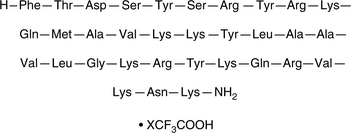
PACAP (6-38) (human, chicken, mouse, ovine, porcine, rat) (trifluoroacetate salt)
Item No. 24554
Technical Information
- Pituitary Adenylate Cyclase-activating Peptide (6-38)
Shipping & Storage Information
Recommended Products
Certificates of Analysis & Batch Specific Data
Provide batch numbers separated by commas to download or request available product inserts, QC sheets, certificates of analysis, data packs, and GC-MS data.

Visit Our Cancer Resource Center
Find Tools & Resources to Study the Hallmarks of Cancer
- Cancer cell signaling & regulation
- Cancer metabolism
- Tumor microenvironment
Product Description
Pituitary adenylate cyclase-activating peptide (PACAP) (6-38) is a PACAP receptor antagonist with IC50 values of 30, 600, and 40 nM, respectively for rat PAC1, rat VPAC1, and human VPAC2 recombinant receptors expressed in CHO cells.1 It binds to PACAP receptors in rat brain membrane (IC50 = 39.14 nM) and to SH-SY5Y and SK-N-MC human neuroblastoma and T47D human breast cancer cells (IC50s = 2.9, 129, and 227 nM, respectively).2,3 In vivo, in newborn pigs, PACAP (6-38) (10 μM) inhibits vasodilation of pial arterioles induced by PACAP (1-38) (Item No. 24770), the full-length peptide.4 It also inhibits decreased food intake and reduced body weight in rats induced by cocaine- and amphetamine-regulated transcript peptides (CARTp) following intracerebroventricular administration of 0.3-3 mol per animal doses.5
WARNING This product is not for human or veterinary use.
References & Product Citations
1. Fragments of pituitary adenylate cyclase activating polypeptide discriminate between type I and II recombinant receptors. Eur. J. Pharmacol. 287(1), 7-11 (1995).
2. Functional characterization of structural alterations in the sequence of the vasodilatory peptide maxadilan yields a pituitary adenylate cyclase-
3. Maxadilan interacts with receptors for pituitary adenylyl cyclase activating peptide in human SH-
4. Pituitary adenylate cyclase-
5. Pituitary adenylate cyclase-
Contact Info
Cayman Chemical1180 East Ellsworth RoadAnn Arbor, Michigan 48108 USAToll Free: (800) 364-9897(USA and Canada only)Fax: (734) 971-3640


