
A neuropeptide with diverse biological activities
Technical Support & Resources

Information provided in the product description is from published literature. Due to the nature of scientific experimentation, your results (e.g., selectivity and effective concentrations) or specific application for this product may differ. If you have questions about how this product fits your application, please contact our technical support staff.

Visit our FAQ

Contact Us

Toll Free Phone (USA and Canada Only): (888) 526-5351
Direct Phone: (734) 975-3888
Request Technical Support

Technical Support Request

To streamline the process attach the appropriate questionnaire to your inquiry.

Download IHC QuestionnaireDownload WB Questionnaire

View Our Privacy Statement for details on how we use and protect your data. In addition, this site is protected by hCaptcha and its Privacy Policy and Terms of Service apply.

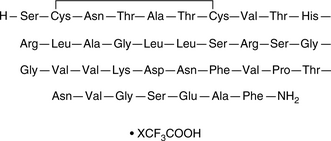
α-CGRP (rat) (trifluoroacetate salt)

Item No. 24728

Technical Information
Formal Name
L-seryl-L-cysteinyl-L-asparaginyl-L-threonyl-L-alanyl-L-threonyl-L-cysteinyl-L-valyl-L-threonyl-L-histidyl-L-arginyl-L-leucyl-L-alanylglycyl-L-leucyl-L-leucyl-L-seryl-L-arginyl-L-serylglycylglycyl-L-valyl-L-valyl-L-lysyl-L-α-aspartyl-L-asparaginyl-L-phenylalanyl-L-valyl-L-prolyl-L-threonyl-L-asparaginyl-L-valylglycyl-L-seryl-L-α-glutamyl-L-alanyl-L-phenylalaninamide, cyclic (2→7)-disulfide, trifluoroacetate salt
Synonyms
  • Calcitonin Gene-Related Peptide-1 (rat)
  • α-Calcitonin Gene-Related Peptide (rat)
  • CGRP-1 (rat)
Molecular Formula
C162H262N50O52S2 • XCF3COOH
Formula Weight
Purity
≥95%
A lyophilized powder
Water: 1 mg/ml
SMILES
NC([C@@H](NC([C@@H](NC([C@H](CCC(O)=O)NC([C@H](CO)NC(CNC([C@H](C(C)C)NC([C@H](CC(N)=O)NC([C@@]([C@@H](C)O)([H])NC([C@@H]1CCCN1C([C@H](C(C)C)NC([C@@H](NC([C@H](CC(N)=O)NC([C@@H](NC([C@H](CCCCN)NC([C@H](C(C)C)NC([C@H](C(C)C)NC(CNC(CNC([C@H](CO)NC([C@H](CCCNC(N)=N)NC([C@H](CO)NC([C@H](CC(C)C)NC([C@H](CC(C)C)NC(CNC([C@@H](NC([C@H](CC(C)C)NC([C@H](CCCNC(N)=N)NC([C@@H](NC([C@@]([C@@H](C)O)([H])NC([C@H](C(C)C)NC([C@@H](NC([C@@]([C@@H](C)O)([H])NC([C@@H](NC([C@@]([C@@H](C)O)([H])NC([C@H](CC(N)=O)N2)=O)=O)C)=O)=O)CSSC[C@H](NC([C@H](CO)N[H])=O)C2=O)=O)=O)=O)CC3=CN=CN3)=O)=O)=O)C)=O)=O)=O)=O)=O)=O)=O)=O)=O)=O)=O)=O)CC(O)=O)=O)=O)CC4=CC=CC=C4)=O)=O)=O)=O)=O)=O)=O)=O)=O)C)=O)CC5=CC=CC=C5)=O.FC(F)(C(O)=O)F
InChi Code
InChI=1S/C162H262N50O52S2.C2HF3O2/c1-71(2)49-95(184-114(225)62-177-129(233)79(17)181-138(242)96(50-72(3)4)191-136(240)91(40-32-46-174-161(169)170)186-141(245)99(54-88-59-173-70-180-88)197-158(262)127(85(23)220)211-155(259)122(77(13)14)205-150(254)108-69-266-265-68-107(201-132(236)89(164)64-213)149(253)195-101(56-111(166)222)146(250)209-124(82(20)217)156(260)183-81(19)131(235)208-125(83(21)218)159(263)202-108)139(243)192-97(51-73(5)6)140(244)200-106(67-216)148(252)187-92(41-33-47-175-162(171)172)137(241)199-104(65-214)133(237)178-60-113(224)176-61-116(227)203-120(75(9)10)154(258)206-121(76(11)12)153(257)189-90(39-30-31-45-163)135(239)196-103(58-118(230)231)143(247)194-100(55-110(165)221)142(246)193-98(53-87-37-28-25-29-38-87)144(248)207-123(78(15)16)160(264)212-48-34-42-109(212)151(255)210-126(84(22)219)157(261)198-102(57-112(167)223)145(249)204-119(74(7)8)152(256)179-63-115(226)185-105(66-215)147(251)188-93(43-44-117(228)229)134(238)182-80(18)130(234)190-94(128(168)232)52-86-35-26-24-27-36-86;3-2(4,5)1(6)7/h24-29,35-38,59,70-85,89-109,119-127,213-220H,30-34,39-58,60-69,163-164H2,1-23H3,(H2,165,221)(H2,166,222)(H2,167,223)(H2,168,232)(H,173,180)(H,176,224)(H,177,233)(H,178,237)(H,179,256)(H,181,242)(H,182,238)(H,183,260)(H,184,225)(H,185,226)(H,186,245)(H,187,252)(H,188,251)(H,189,257)(H,190,234)(H,191,240)(H,192,243)(H,193,246)(H,194,247)(H,195,253)(H,196,239)(H,197,262)(H,198,261)(H,199,241)(H,200,244)(H,201,236)(H,202,263)(H,203,227)(H,204,249)(H,205,254)(H,206,258)(H,207,248)(H,208,235)(H,209,250)(H,210,255)(H,211,259)(H,228,229)(H,230,231)(H4,169,170,174)(H4,171,172,175);(H,6,7)/t79-,80-,81-,82+,83+,84+,85+,89-,90-,91-,92-,93-,94-,95-,96-,97-,98-,99-,100-,101-,102-,103-,104-,105-,106-,107-,108-,109-,119-,120-,121-,122-,123-,124-,125-,126-,127-;/m0./s1
InChi Key
FHIMUMUFXADYPA-OILNABKMSA-N
Shipping & Storage Information
Storage
-20°C
Shipping
Room temperature in continental US; may vary elsewhere
Recommended Products

Certificates of Analysis & Batch Specific Data

Provide batch numbers separated by commas to download or request available product inserts, QC sheets, certificates of analysis, data packs, and GC-MS data.

    Add

    Add

    Product Description

    α-Calcitonin gene-related peptide (α-CGRP) is a neuropeptide with roles in vasodilation, cardiovascular regulation, and inflammation.1 It belongs to the calcitonin family of peptides, which also includes amylin (Item No. 24274), calcitonin (Item Nos. 24409 | 24410), and adrenomedullin.2 α-CGRP binds selectively to heterotrimeric complexes of calcitonin receptor-like receptor (CRLR) and receptor activity-modifying proteins RAMP 1 or 3 (RAMP1 and 3; IC50s = 7 and 23 nM, respectively) over a complex of CRLR and RAMP2 (IC50 = >1,000 nM).3 It binds to rat brain and spleen membrane preparations (IC50s = 3.9 and 3.5 nM, respectively) and relaxes human cerebral and middle meningeal arterial segments precontracted with prostaglandin F (PGF; Item No. 16010; IC50s = 0.23 and 2.24 nM, respectively).4,5 In vivo, α-CGRP (0.01-3,000 ng/kg) decreases mean arterial blood pressure (MABP) and increases pial arteriole (PA) and middle meningeal artery (MMA) diameters in rats with closed cranial windows.6 It induces a 50% increase in diameter of arterioles precontracted with human endothelin-1 (ET-1; Item No. 24127) in vivo in hamster cheek pouch at a concentration of 39.8 pM.7

    WARNING This product is not for human or veterinary use.

    References & Product Citations
    Product Description References

    1. Russell, F.A., King, R., Smillie, S.-J., et alCalcitonin gene-related peptide: Physiology and pathophysiology. Physiol. Rev. 94(4), 1099-1142 (2014).

    2. Wimalawansa, S.J. Amylin, calcitonin gene-related peptide, calcitonin, and adrenomedullin: A peptide superfamily. Crit. Rev. Neurobiol. 11(2-3), 167-239 (1997).

    3. Husmann, K., Born, W., Fischer, J.A., et alThree receptor-activity-modifying proteins define calcitonin gene-related peptide or adrenomedullin selectivity of the mouse calcitonin-like receptor in COS-7 cells. Biochem. Pharmacol. 66(11), 2107-2115 (2003).

    4. Dennis, T., Fournier, A., St. Pierre, S., et alStructure-activity profile of calcitonin gene-related peptide in peripheral and brain tissues. Evidence for receptor multiplicity. J. Pharmacol. Exp. Ther. 251(2), 718-725 (1989).

    5. Jansen-Olesen, I., Jørgensen, L., Engel, U., et alIn-depth characterization of CGRP receptors in human intracranial arteries. Eur. J. Pharmacol. 481(2-3), 207-216 (2003).

    6. Petersen, K.A., Birk, S., Doods, H., et alInhibitory effect of BIBN4096BS on cephalic vasodilatation induced by CGRP or transcranial electrical stimulation in the rat. Br. J. Pharmacol. 143(6), 697-704 (2004).

    7. Hall, J.M., and Brain, S.D. Interaction of amylin with calcitonin gene-related peptide receptors in the microvasculature of the hamster cheek pouch in vivo. Br. J. Pharmacol. 126(1), 280-284 (1999).

