
Technical Support & Resources
Visit our FAQ
Contact Us
Toll Free Phone (USA and Canada Only): (888) 526-5351
Direct Phone: (734) 975-3888
Adenosine A2A Receptor (human, recombinant)
Item No. 24730
Technical Information
Shipping & Storage Information
Recommended Products
Certificates of Analysis & Batch Specific Data
Provide batch numbers separated by commas to download or request available product inserts, QC sheets, certificates of analysis, data packs, and GC-MS data.
Cannabinoid Resource Center
Discover Our Tools to Support Cannabinoid Research and Analysis.
- Cannabinoid signaling research products
- Analytical standards and certified reference materials
- Endocannabinoid profiling services
- Lab wall posters
- Articles, application notes, and webinars
Product Description
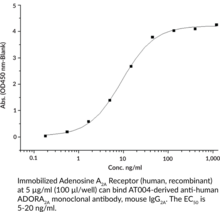
Adenosine A2A receptor (human, recombinant) contains amino acids corresponding to the full length, wild-type, human A2A receptor, as well as N-terminal histidine and streptavidin tags with a TEV protease cleavage site. The A2A receptor is a G protein-coupled receptor (GPCR) that is activated by adenosine on presynaptic terminals to induce neurotransmitter release and on postsynaptic terminals to increase excitability.1 Signaling through the A2A receptor occurs through Gs, Golf, and G15/16 proteins to increase cyclic AMP or inositol-(1,4,5)-trisphosphate (IP3) activity.2 It is expressed in the brain on striatal-pallidal GABAergic neurons and in the olfactory bulb as well as other brain regions. It is also expressed in the periphery in organs and cells involved with immune function, including the spleen, thymus, leukocytes, and blood platelets as well as in the heart, lung, and blood vessels. A2A receptor activity induced by agonists has neurodegenerative effects, which has led to the development of A2A receptor antagonists, but has shown mixed effects on seizure activity in rodent models.1 The A2A receptor also plays a role in the regulation of enteric nervous system function, vasodilation of coronary arteries, and the immune response.3 In addition to signaling through the A2A receptor alone, it can form heteromers with other GPCRs, including adenosine A1, dopamine D2 and D3, cannabinoid CB1, and metabotropic glutamate receptor 5 (mGluR5).4,5 The function of these receptors is influenced by the interaction, with the A2A receptor decreasing dopamine binding to the D2 receptor and mGluR5 potentiating the effects of the A2A receptor on adenylyl cyclase and MAPK signaling.4 Cayman's Adenosine A2A Receptor (human, recombinant) protein is provided in a virus-like particle (VLP) format, which helps maintain this membrane protein in a native-like conformation and lipid environment for use in binding assays. This protein consists of 420 amino acids and has a calculated molecular weight of 45.71 kDa.
WARNING This product is not for human or veterinary use.
References & Product Citations
1. Adenosine A1 and A2A receptors in the brain: Current research and their role in neurodegeneration. Molecules 22(4), pii: E676 (2017).
2. Structure and function of adenosine receptors and their genes. Naunyn Schmiedebergs Arch. Pharmacol. 362(4-5), 364-374 (2000).
3. The adenosinergic system as a therapeutic target in the vasculature: New ligands and challenges. Molecules 22(5), pii: E752 (2017).
4. Adenosine receptor heteromers and their integrative role in striatal function. ScientificWorldJournal 7, 74-85 (2007).
5. Adenosine A2A receptor and dopamine D3 receptor interactions: Evidence of functional A2A/D3 heteromeric complexes. Mol. Pharmacol. 67(2), 400-407 (2005).
Contact Info
Cayman Chemical1180 East Ellsworth RoadAnn Arbor, Michigan 48108 USAToll Free: (800) 364-9897(USA and Canada only)Fax: (734) 971-3640


