
Technical Support & Resources
Information provided in the product description is from published literature. Due to the nature of scientific experimentation, your results (e.g., selectivity and effective concentrations) or specific application for this product may differ. If you have questions about how this product fits your application, please contact our technical support staff.
Visit our FAQ
Contact Us
Toll Free Phone (USA and Canada Only): (888) 526-5351
Direct Phone: (734) 975-3888
Product Categories
Research Area
Application

Technical Information
- 10-nonyl Acridine Orange
Shipping & Storage Information
Recommended Products

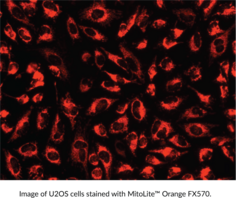
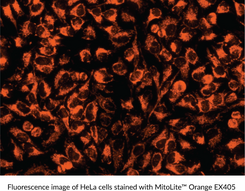

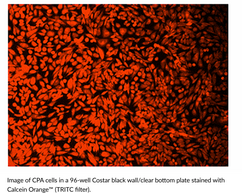
Certificates of Analysis & Batch Specific Data
Provide batch numbers separated by commas to download or request available product inserts, QC sheets, certificates of analysis, data packs, and GC-MS data.
Product Description
Acridine orange 10-nonyl is a mitochondrial dye and derivative of acridine orange (Item No. 14338) that incorporates into the cardiolipin-rich inner mitochondrial membrane.1 It selectively binds to cardiolipin-containing liposomes over phosphatidylserine- and phosphatidylinositol-containing liposomes in vitro (Kas = 0.002, 7,000, and 7,000 mM, respectively). Acridine orange 10-nonyl binding to mitochondria is abolished by the mitochondrial uncoupler FCCP (Item No. 15218) in rat cortical astrocytes, neonatal cardiomyocytes, and isolated brain mitochondria, indicating dependence on mitochondrial membrane potential.2 Acridine orange 10-nonyl displays excitation/emission maxima of 490/510 nm, respectively, and has been used to quantify cardiolipin content and mitochondrial mass in isolated mitochondria and cellular systems.
WARNING This product is not for human or veterinary use.
References & Product Citations
1. 10N-
2. Intracellular distribution of the fluorescent dye nonyl acridine orange responds to the mitochondrial membrane potential: Implications for assays of cardiolipin and mitochondrial mass. J. Neurochem. 82(2), 224-233 (2002).
Contact Info
Cayman Chemical1180 East Ellsworth RoadAnn Arbor, Michigan 48108 USAToll Free: (800) 364-9897(USA and Canada only)Fax: (734) 971-3640


