
Technical Support & Resources
Visit our FAQ
Contact Us
Toll Free Phone (USA and Canada Only): (888) 526-5351
Direct Phone: (734) 975-3888
Product Categories
Technical Information
- APG5-like
- hAPG5
- Apoptosis-specific Protein
- Autophagy Protein 5
- Autophagy-related 5
Shipping & Storage Information
Recommended Products
Certificates of Analysis & Batch Specific Data
Provide batch numbers separated by commas to download or request available product inserts, QC sheets, certificates of analysis, data packs, and GC-MS data.

Visit Our Cancer Resource Center
Find Tools & Resources to Study the Hallmarks of Cancer
- Cancer cell signaling & regulation
- Cancer metabolism
- Tumor microenvironment
Product Description
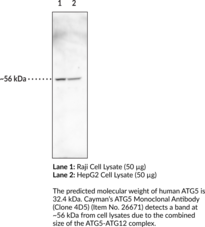
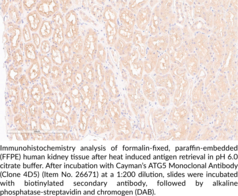
Autophagy-related 5 (ATG5), formerly known as apoptosis-specific protein (ASP), is a protein that is essential to autophagosome elongation.1,2,3 ATG5 is covalently conjugated to the C-terminal glycine residue of ATG12 (ATG12-ATG5) and forms a non-covalent complex with ATG16 (ATG12-ATG5-ATG16), which functions as an E3 ubiquitin ligase-like enzyme to facilitate LC3 transfer from ATG3 to phosphatidylethanolamine in canonical autophagy. ATG12-ATG5 also binds to the ATG12-ATG5-interaction region of the lysosomally localized protein TECPR1, freeing the TECPR1 pleckstrin homology domain to interact with phosphatidylinositol 3-phosphate components in the autophagosome membrane, promoting autophagosome-lysosome fusion.3 Polymorphisms in ATG5 have been associated with various autoimmune diseases, including lupus nephritis and Behçet's disease, gastrointestinal and colorectal cancers, as well as sporadic Parkinson's disease and childhood asthma. Cayman’s ATG5 Monoclonal Antibody (Clone 4D5) can be used for ELISA, immunohistochemistry, and Western blot applications. The antibody recognizes the ATG5-ATG12 complex at approximately 56 kDa from human samples.
WARNING This product is not for human or veterinary use.
References & Product Citations
1. Structure of the human ATG12~ATG5 conjugate required for LC3 lipidation in autophagy. Nat. Struct. Mol. Biol. 20(1), 59-66 (2013).
2. Insights into autophagosome maturation revealed by the structures of ATG5 with its interacting partners. Autophagy 11(1), 75-87 (2015).
3. Exploring the role of autophagy-
Contact Info
Cayman Chemical1180 East Ellsworth RoadAnn Arbor, Michigan 48108 USAToll Free: (800) 364-9897(USA and Canada only)Fax: (734) 971-3640


