
Features
- Screen test samples to quantify functional activity, either agonist or antagonist, that they may exert against human CAR2
- Robust technology provides sustained response for consistent and reproducible data acquistion
- Included in kit: Ready-to-use, pre-transfected reporter cells | Optimized media | Positive control agonist | Luciferase Detection Reagent | Cell culture ready assay plate
- Provides low-nanomolar sensitivities to drugs that are inhibitors of P-gp
Technical Support & Resources
Visit our FAQ
Contact Us
Toll Free Phone (USA and Canada Only): (888) 526-5351
Direct Phone: (734) 975-3888
Product Categories
Product Type
Application
Human Constitutive Androstane Receptor, isoform 2 Reporter Assay System
Item No. 27097
Technical Information
- CAR2
- NR1I3i2
Shipping & Storage Information
Recommended Products
Certificates of Analysis & Batch Specific Data
Provide batch numbers separated by commas to download or request available product inserts, QC sheets, certificates of analysis, data packs, and GC-MS data.


Explore Obesity & Metabolic Disease Resources
Discover high-quality research tools to investigate GLP-1 mechanisms and next-generation metabolic targets.
OBESITY RESEARCH SOLUTIONSProduct Description
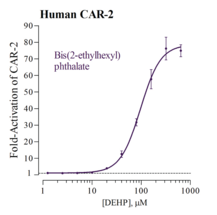
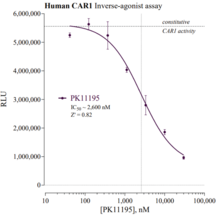
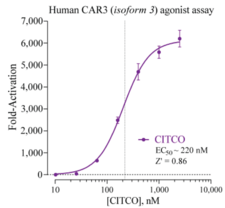
The constitutive androstane receptor (CAR), also known as NR1I3 (nuclear receptor subfamily 1, group I, member 3), is a nuclear hormone receptor with activity similar to that seen in other steroid receptors such as estrogen or progesterone but more similar in form to PPAR, LXR and RXR. CAR functions differently from other steroid receptors and its activity is still being elucidated.It is known to act in concert with PXR to detoxify xenobiotics. CAR is encoded by the NR1I3 gene. This gene encodes a member of the nuclear receptor superfamily, and is a key regulator of xenobiotic and endobiotic metabolism. The protein binds to DNA as a monomer or a heterodimer with the retinoid X receptor and regulates the transcription of target genes involved in drug metabolism and bilirubin clearance, such as cytochrome P450 family members. Unlike most nuclear receptors, this transcriptional regulator is constitutively active in the absence of ligand but is regulated by both agonists and inverse agonists. Ligand binding results in translocation of this protein to the nucleus, where it activates or represses target gene transcription. These ligands include bilirubin, a variety of foreign compounds, steroid hormones, and prescription drugs. Multiple transcript variants encoding different isoforms have been found for this gene. CAR exists as three predominant splice variants in humans depicted as CAR-1, CAR-2 and CAR-3. Each has unique biological properties. These splice variants do not exist in rat and mouse. Unlike CAR-1, CAR-2 is not constitutively active, showing ligand-dependent activation of reporter genes linked to genetic response elements derived from CYP2B6 or CYP3A4 promoters. Diethylhexyl phthalate (DEHP) is a strong agonist of CAR-2 but has no activity toward CAR-1 or CAR-3. It is noteworthy, and a source of experimental confusion, that a number of xenobiotics characterized as activators of human CAR (including phenobarbital) actually modulate the receptor's activity via indirect mechanisms. In other words, such chemicals do not directly bind to CAR; rather, they impact the activity of upstream regulatory mechanisms that impinge on CAR activity. Hybrid nuclear receptors in which the native N-terminal DNA binding domain (DBD) has been substituted with the GAL4 DBD, such as is used in this reporter assay system, likely will not be responsive to chemical modulators that act through indirect mechanisms. CAR-2 Reporter Cells are prepared using INDIGO’s proprietary CryoMite™ process. This cryo-preservation method yields high cell viability post-thaw, and provides the convenience of immediately dispensing healthy, division-competent reporter cells into assay plates. There is no need for intermediate spin-and-wash steps, viability determinations, or cell titer adjustments. [INDIGO Catalog Nos. IB00921-32, IB00921, IB00922]
WARNING This product is not for human or veterinary use.
Contact Info
Cayman Chemical1180 East Ellsworth RoadAnn Arbor, Michigan 48108 USAToll Free: (800) 364-9897(USA and Canada only)Fax: (734) 971-3640


