
Technical Support & Resources
Visit our FAQ
Contact Us
Toll Free Phone (USA and Canada Only): (888) 526-5351
Direct Phone: (734) 975-3888
Technical Information
- hBG37
- GPBAR1
- hGPCR19
- GPR131
- G Protein-Coupled Bile Acid Receptor 1
- M-BAR
- Membrane-Type Receptor for Bile Acids
Shipping & Storage Information
Recommended Products
Certificates of Analysis & Batch Specific Data
Provide batch numbers separated by commas to download or request available product inserts, QC sheets, certificates of analysis, data packs, and GC-MS data.

Explore Obesity & Metabolic Disease Resources
Discover high-quality research tools to investigate GLP-1 mechanisms and next-generation metabolic targets.
OBESITY RESEARCH SOLUTIONSProduct Description
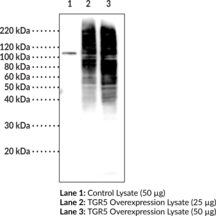
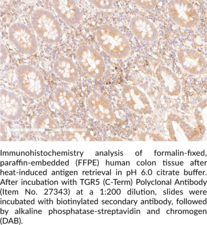
TGR5, also known as GPBAR1, is a G protein-coupled receptor (GPCR) belonging to the bile acid receptor subclass.1 It is a plasma membrane-bound transmembrane protein and is primarily expressed in spleen and placenta. TGR5 is activated by the endogenous bile acids cholic acid (Item No. 20250), lithocholic acid (Item No. 20253), taurolithocholic acid (Item No. 17275), deoxycholic acid (Item Nos. 20756 | 18231), and chenodeoxycholic acid (Item No. 10011286), among others. Activation of TGR5 by the synthetic agonist INT-777 (Item No. 17678) decreases plasma triglyceride levels and urinary levels of albumin, thiobarbituric acid reactive substances (TBARS), and hydrogen peroxide, as well as prevents diabetic nephropathy, in a db/db mouse model of diabetes.2 Activation of TGR5 by INT-777 also prevents hepatic steatosis and increases in fat, liver, and brown adipose tissue mass in a mouse model of diet-induced obesity.3 Transgenic overexpression of TGR5 increases glucose tolerance, as well as plasma levels of insulin and glucagon-like peptide 1 (GLP-1), during an oral glucose tolerance test in mice fed a high-fat diet. Increased expression of TGR5 has been found in tissue samples from patients with intestinal-type adenocarcinoma or intestinal metaplasia, but not healthy mucosa.4 TGR5 protein levels are also increased in patient-derived Barrett's esophagous and esophageal adenocarcinoma tissues.5 Cayman's TGR5 (C-Term) Polyclonal Antibody can be used for Western blot and immunohistochemistry (IHC) applications. The antibody recognizes the C-terminal region of TGR5 from human samples.
WARNING This product is not for human or veterinary use.
References & Product Citations
1. TGR5: An emerging bile acid G-
2. G protein-
3. New insights into type II NAD(P)H:quinone oxidoreductases. Microbiol. Mol. Biol. Rev. 68(4), 603-616 (2004).
4. Expression of bile acid receptor TGR5 in gastric adenocarcinoma. Am. J. Physiol. Gastrointest. Liver Physiol. 304(4), G322-G327 (2013).
5. Role of a novel bile acid receptor TGR5 in the development of oesophageal adenocarcinoma. Gut 59(2), 170-180 (2010).
Contact Info
Cayman Chemical1180 East Ellsworth RoadAnn Arbor, Michigan 48108 USAToll Free: (800) 364-9897(USA and Canada only)Fax: (734) 971-3640


