
Technical Support & Resources
Visit our FAQ
Contact Us
Toll Free Phone (USA and Canada Only): (888) 526-5351
Direct Phone: (734) 975-3888
Product Categories
Product Type
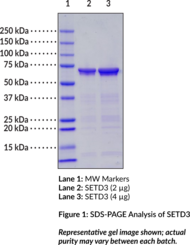
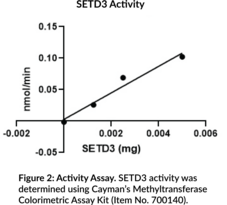
Technical Information
- Actin Histidine Methyltransferase
- Actin Histidine N-Methyltransferase
- C14orf154
- Chromosome 14 Open Reading Frame 154
- HSETD3
- SET Doman-Containing 3
- SET Domain-Containing Protein 3
Shipping & Storage Information
Recommended Products
Certificates of Analysis & Batch Specific Data
Provide batch numbers separated by commas to download or request available product inserts, QC sheets, certificates of analysis, data packs, and GC-MS data.
Product Description
SET domain protein 3 (SETD3) is an actin histidine methyltransferase encoded by the SETD3 gene in humans and a member of the SET family of methyltransferases.1 It contains an N-terminal SET domain, responsible for transferring a methyl group from S-adenosyl methionine to histidine 73 on β-actin, that forms a cleft with a C-terminal domain that is similar to large subunit methyltransferase (LSMT) domains.2 SETD3 is ubiquitously expressed and localizes to the cytoplasm. SETD3 expression in liver cancer cell lines increases proliferation while shRNA knockdown decreases it.1 Expression of SETD3 increases tumor size in a HepG2 mouse xenograft model, and a xenograft model using cancer cells with an endogenous knockdown of SETD3 reduces tumor size. SETD3 protein levels are increased in isolated human cancer tissues compared with adjacent tissue. Setd3 knockout in mice leads to skeletal muscle myopathy, abnormal cardiac electrocardiogram, and, in female mice, delayed parturition.2 Cayman’s SETD3 (human, recombinant) protein can be used for Western blot, ELISA, and enzymatic assay applications.
WARNING This product is not for human or veterinary use.
References & Product Citations
1. Cell cycle-
2. SETD3 is an actin histidine methyltransferase that prevents primary dystocia. Nature 585(7739), 372-376 (2019).
Contact Info
Cayman Chemical1180 East Ellsworth RoadAnn Arbor, Michigan 48108 USAToll Free: (800) 364-9897(USA and Canada only)Fax: (734) 971-3640


