
Technical Support & Resources
Visit our FAQ
Contact Us
Toll Free Phone (USA and Canada Only): (888) 526-5351
Direct Phone: (734) 975-3888
Product Categories
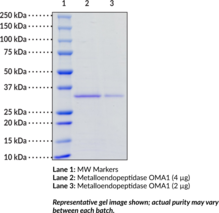
Metalloendopeptidase OMA1 (human, recombinant)
Item No. 28258
Technical Information
- Metalloprotease-related Protein 1
- MPRP-1
- OMA1
- Overlapping with the m-AAA Protease 1 Homolog
Shipping & Storage Information
Recommended Products
Certificates of Analysis & Batch Specific Data
Provide batch numbers separated by commas to download or request available product inserts, QC sheets, certificates of analysis, data packs, and GC-MS data.

Explore Obesity & Metabolic Disease Resources
Discover high-quality research tools to investigate GLP-1 mechanisms and next-generation metabolic targets.
OBESITY RESEARCH SOLUTIONSProduct Description
OMA1 is an ATP-independent metalloproteinase encoded by OMA1.1 It is localized to the mitochondrial inner membrane and is comprised of a matrix-facing N-terminal domain, a transmembrane domain, and a C-terminal M48 metallopeptidase domain that is exposed to the intermembrane space.1,2 Under various stress conditions, including oxidative stress, heat stress, and mitochondrial membrane depolarization, OMA1 is activated and cleaves long isoforms of the GTPase optic atrophy 1 (OPA1) at the S1 cleavage site, leading to inhibition of mitochondrial fusion and increased mitochondrial fragmentation.1,2,3 Under stress conditions, OMA1 is also autocatalytically degraded, thereby limiting, and allowing for reversal of, the stress response.2,3 Oma1-/- mouse embryonic fibroblasts exhibit a loss of mitochondrial fragmentation upon exposure to hydrogen peroxide.2 Mice lacking Oma1 exhibit impaired thermogenesis, increased hepatic steatosis and serum triglyceride levels, and high-fat diet-induced obesity.4 Cayman’s Metalloendopeptidase OMA1 (human, recombinant) can be used for Western blot and ELISA applications.
WARNING This product is not for human or veterinary use.
References & Product Citations
1. Metalloproteases of the inner mitochondrial membrane. Biochemistry 56(36), 4737-4746 (2017).
2. Stress-
3. New roles for mitochondrial proteases in health, ageing and disease. Nat. Rev. Mol. Cell Biol. 16(6), 345-359 (2015).
4. Loss of mitochondrial protease OMA1 alters processing of the GTPase OPA1 and causes obesity and defective thermogenesis in mice. EMBO J. 31(9), 2117-2133 (2012).
Contact Info
Cayman Chemical1180 East Ellsworth RoadAnn Arbor, Michigan 48108 USAToll Free: (800) 364-9897(USA and Canada only)Fax: (734) 971-3640


