
Technical Support & Resources
Visit our FAQ
Contact Us
Toll Free Phone (USA and Canada Only): (888) 526-5351
Direct Phone: (734) 975-3888
Product Categories


Technical Information
- Fat Mass- and Obesity-associated Protein
- α-Ketoglutarate-dependent Dioxygenase FTO
Shipping & Storage Information
Recommended Products
Certificates of Analysis & Batch Specific Data
Provide batch numbers separated by commas to download or request available product inserts, QC sheets, certificates of analysis, data packs, and GC-MS data.

Explore Obesity & Metabolic Disease Resources
Discover high-quality research tools to investigate GLP-1 mechanisms and next-generation metabolic targets.
OBESITY RESEARCH SOLUTIONSProduct Description
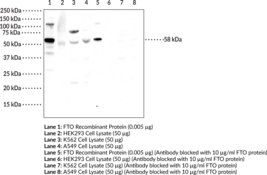
Fat mass and obesity-associated (FTO) protein is a nuclear-residing N6-methyladenosine (m6A) RNA demethylase that is encoded by the FTO gene in humans.1,2,3 It is composed of an N-terminal domain similar in structure to members of the AlkB non-heme iron-containing dioxygenase family and a C-terminal domain that is not similar to other known domains.4 The N-terminal domain contains a loop not found in other AlkB proteins that may be responsible for its specificity for single-stranded nucleic acids. FTO is highly expressed during development and in the adult brain, adipose tissue, and muscle and its expression is modified by the availability of essential amino acids in vitro and following fasting or a chronic high-fat diet in vivo in mice.3,5,6 FTO regulates mRNA splicing and is required for adipogenesis.1,7 Knockdown of Fto in mice increases m6A-containing transcripts of the adipogenesis-related gene Runx1t1, enhances binding of the splicing regulatory protein Srsf2 to Runx1t1, which induces the inclusion of Runx1t1 exon 6 and the production of long Runx1t1 transcripts, and leads to inhibition of pre-adipocyte differentiation. Fto is associated with obesity in transgenic mouse models, with overexpression increasing food intake and weight gain and knockout reducing body weight, body length, fat mass, and white adipose tissue, as well as increasing energy expenditure while decreasing locomotor activity.2 FTO SNPs are associated with body mass index and obesity risk in humans.6,8 Cayman's FTO (human) Polyclonal Antibody can be used for ELISA, Immunoflourescence (IF), Immunohistochemistry (IHC), and Western blot (WB) applications. The antibody recognizes FTO at 58 kDa from human samples.
WARNING This product is not for human or veterinary use.
References & Product Citations
1. FTO-
2. Inactivation of the Fto gene protects from obesity. Nature 458(7240), 894-899 (2009).
3. FTO is expressed in neurones throughout the brain and its expression is unaltered by fasting. PLoS One 6(11), e27968 (2011).
4. Crystal structure of the FTO protein reveals basis for its substrate specificity. Nature 464(7292), 1205-1209 (2010).
5. FTO expression is regulated by availability of essential amino acids. Int. J. Obes. (Lond.) 37(5), 744-747 (2013).
6. Role for the obesity-
7. FTO: Linking m6A demethylation to adipogenesis. Cell Res. 25(1), 3-4 (2015).
8. The bigger picture of FTO: The first GWAS-
Contact Info
Cayman Chemical1180 East Ellsworth RoadAnn Arbor, Michigan 48108 USAToll Free: (800) 364-9897(USA and Canada only)Fax: (734) 971-3640


