
Technical Support & Resources
Information provided in the product description is from published literature. Due to the nature of scientific experimentation, your results (e.g., selectivity and effective concentrations) or specific application for this product may differ. If you have questions about how this product fits your application, please contact our technical support staff.
Visit our FAQ
Contact Us
Toll Free Phone (USA and Canada Only): (888) 526-5351
Direct Phone: (734) 975-3888
Product Categories

Technical Information
Shipping & Storage Information
Recommended Products
Certificates of Analysis & Batch Specific Data
Provide batch numbers separated by commas to download or request available product inserts, QC sheets, certificates of analysis, data packs, and GC-MS data.
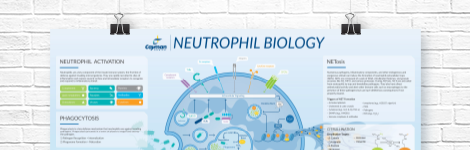
Neutrophil Biology Wall Poster
Explore how neutrophils shape the immune response in health and disease. This poster highlights neutrophil pathogen defense mechanisms, including phagocytosis, degranulation, and NETosis, as well as neutrophil roles in inflammation and NET-associated pathologies.
DOWNLOAD NOWProduct Description
Cyclosporin C is a fungal metabolite that has been found in T. inflatum and has diverse biological activities, including antifungal, antiviral, and immunosuppressant properties.1,2,3,4 It is active against isolates of B. cinerea, A. niger, and Alternaria, Mucor, and Penicillium species (MICs = 0.1-5 μg/ml).2 Cyclosporin C (15 μg/ml) inhibits vaccinia virus replication in infected BSC40 cells by 98.82%.3 It inhibits lymphocyte proliferation induced by the mitogens concanavalin A (ConA; Item No. 14951), phytohemagglutinin L (PHA), and pokeweed mitogen (PWM), as well as proliferation induced by alloantigen in mixed lymphocyte culture when used at a concentration of 100 ng/ml.4 Cyclosporin C (100 ng/ml) inhibits the local graft versus host (GVH) reaction in mice receiving splenocyte grafts.
WARNING This product is not for human or veterinary use.
References & Product Citations
1. Cyclosporins, fungal metabolites with immunosuppressive activities. Prog. Med. Chem. 25, 1-33 (1988).
2. Cyclosporin C is the main antifungal compound produced by Acremonium luzulae. Appl. Environ. Microbiol. 63(5), 1739-1743 (1997).
3. Inhibition of vaccinia virus replication by cyclosporin A analogues correlates with their affinity for cellular cyclophilins. J. Gen. Virol. 79(Pt 2), 339-346 (1998).
4. In vitro and in vivo comparative studies on immunosuppressive properties of cyclosporines A, C, D and metabolites M1, M17 and M21. Immunopharmacol. Immunotoxicol. 15(2-3), 163-177 (1993).
Contact Info
Cayman Chemical1180 East Ellsworth RoadAnn Arbor, Michigan 48108 USAToll Free: (800) 364-9897(USA and Canada only)Fax: (734) 971-3640


