
Technical Support & Resources
Information provided in the product description is from published literature. Due to the nature of scientific experimentation, your results (e.g., selectivity and effective concentrations) or specific application for this product may differ. If you have questions about how this product fits your application, please contact our technical support staff.
Visit our FAQ
Contact Us
Toll Free Phone (USA and Canada Only): (888) 526-5351
Direct Phone: (734) 975-3888
Product Categories
Technical Information
Shipping & Storage Information
Recommended Products
Certificates of Analysis & Batch Specific Data
Provide batch numbers separated by commas to download or request available product inserts, QC sheets, certificates of analysis, data packs, and GC-MS data.

Visit Our Environmental Toxicology Resource Center
Explore additional resources to study natural toxins, pollutants including PFAS and 6-PPD-Q, and their biological effects.
ENVIRONMENTAL TOXICOLOGY TOOLS & SERVICESProduct Description
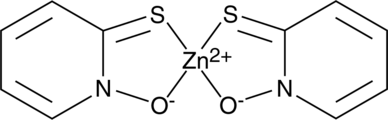
Zinc pyrithione is a coordination complex of zinc and pyrithione that has antimicrobial, anticancer, and fungicidal activities.1,2,3,4 It is active against the bacteria E. coli, S. aureus, K. pneumoniae, A. baumannii, P. aeruginosa, E. faecium, E. faecalis, and E. cloacae (MICs = 1-4 µg/ml) and the fungus P. ovale when used at concentrations ranging from 0.01 to 10 µg/ml.1,2 Zinc pyrithione reduces tumor growth in an SCC-4 mouse xenograft model when administered at a dose of 1 mg/kg per week for six weeks.3 Topical application of zinc pyrithione (0.5-5% w/w) completely prevents Aspergillus growth in soy meal-derived adhesives.4 Formulations containing zinc pyrithione have been used in the treatment of dandruff and in the prevention of fungal growth in industrial applications.
WARNING This product is not for human or veterinary use.
References & Product Citations
1. Zinc pyrithione improves the antibacterial activity of silver sulfadiazine ointment. mSphere 1(5), e00194-00116 (2016).
2. The in vitro antifungal activity of ketoconazole, zinc pyrithione, and selenium sulfide against Pityrosporum and their efficacy as a shampoo in the treatment of experimental pityrosporosis in guinea pigs. J. Am. Acad. Dermatol. 22(6 Pt 1), 993-998 (1990).
3. Anticancer activity of pyrithione zinc in oral cancer cells identified in small molecule screens and xenograft model: Implications for oral cancer therapy. Mol. Oncol. 9(8), 1720-1735 (2015).
4. Improving mildew resistance of soy meal by nano-
Lysosomal Zn2+ release triggers rapid, mitochondria-
Contact Info
Cayman Chemical1180 East Ellsworth RoadAnn Arbor, Michigan 48108 USAToll Free: (800) 364-9897(USA and Canada only)Fax: (734) 971-3640


