
Technical Support & Resources
Visit our FAQ
Contact Us
Toll Free Phone (USA and Canada Only): (888) 526-5351
Direct Phone: (734) 975-3888
Technical Information
- Gemin-1
- Survival Motor Neuron Protein
Shipping & Storage Information
Recommended Products
Certificates of Analysis & Batch Specific Data
Provide batch numbers separated by commas to download or request available product inserts, QC sheets, certificates of analysis, data packs, and GC-MS data.
Product Description
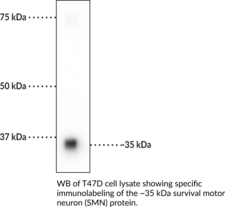
The survival motor neuron (SMN) protein is a ubiquitously expressed, multifunctional protein with roles in a variety of cellular processes, including small nuclear ribonucleoprotein (snRNP) and spliceosome assembly, translation, cytoskeletal dynamics, and stress granule formation.1,2 It is a 294-amino acid protein encoded by SMN1 in humans and is comprised of an N-terminal basic/lysine-rich domain that interacts with RNA and Gemin-2, a central Tudor domain (Item No. 14136) that functions in a variety of protein-protein interactions, a proline-rich region, and a C-terminal YG box that facilitates SMN oligomerization. Humans also have a second centromeric copy of the gene, called SMN2, that is the result of duplication and inversion and primarily produces a truncated isoform, SMNΔ7, which is less stable, but can also produce small amounts of SMN. Knockout of Smn is embryonic lethal in mice.1 In humans, mutations in SMN1 are associated with spinal muscular atrophy (SMA), a neuromuscular disorder characterized by degeneration of α motor neurons in the spinal cord and muscle weakness. Cayman's SMN Monoclonal Antibody can be used for immunocytochemistry (ICC) and Western blot (WB) applications. The antibody recognizes SMN protein at approximately 35 kDa from human, mouse, and rat samples.
WARNING This product is not for human or veterinary use.
References & Product Citations
1. The role of survival motor neuron protein (SMN) in protein homeostasis. Cell. Mol. Life Sci. 75(21), 3877-3894 (2018).
2. Diverse role of survival motor neuron protein. Biochim. Biophys. Acta Gene Regul. Mech. 1860(3), 299-315 (2017).
Contact Info
Cayman Chemical1180 East Ellsworth RoadAnn Arbor, Michigan 48108 USAToll Free: (800) 364-9897(USA and Canada only)Fax: (734) 971-3640


