
Technical Support & Resources
Visit our FAQ
Contact Us
Toll Free Phone (USA and Canada Only): (888) 526-5351
Direct Phone: (734) 975-3888
Product Categories
Application

Technical Information
Shipping & Storage Information
Recommended Products
Certificates of Analysis & Batch Specific Data
Provide batch numbers separated by commas to download or request available product inserts, QC sheets, certificates of analysis, data packs, and GC-MS data.
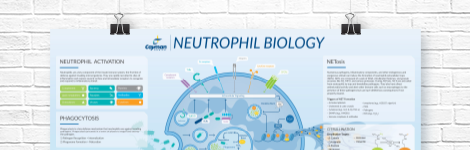
Neutrophil Biology Wall Poster
Explore how neutrophils shape the immune response in health and disease. This poster highlights neutrophil pathogen defense mechanisms, including phagocytosis, degranulation, and NETosis, as well as neutrophil roles in inflammation and NET-associated pathologies.
DOWNLOAD NOWProduct Description
Hydroxyzine-d8 is intended for use as an internal standard for the quantification of hydroxyzine (Item No. 24039) by GC- or LC-MS. Hydroxyzine is a histamine H1 receptor antagonist (Ki = 1.9 nM).1 It binds competitively with the H1 receptor inverse agonist mepyramine (Item No. 20978) with an IC50 value of 80 µM in polymorphonuclear leukocytes.2 In vivo, it is metabolized to the H1 receptor antagonist cetirizine (Item No. 19686).3 In situ, hydroxyzine (10 µM) prevents recruitment of rolling leukocytes induced by histamine in rat mesentery post-capillary venules.4 Hydroxyzine also decreases anxiety-like behavior in mice, increasing the time spent in the open arms of the elevated plus maze and in the light side of the light-dark exploration test.5 Formulations containing hydroxyzine have been used in the treatment of anxiety and as antihistamines in the treatment of allergic rhinitis.
WARNING This product is not for human or veterinary use.
References & Product Citations
1. Binding characteristics of cetirizine and levocetirizine to human H1 histamine receptors: Contribution of Lys191 and Thr194. Mol. Pharmacol. 61(2), 391-399 (2002).
2. Histamine H1 binding site on human polymorphonuclear leukocytes. Inflammation 7(3), 291-300 (1983).
3. Pharmacologically active drug metabolites: Impact on drug discovery and pharmacotherapy. Pharmacol. Rev. 65(2), 578-640 (2013).
4. Role of H1 receptors and P-
5. Evaluation of anxiolytic effects of aripiprazole and hydroxyzine as a combination in mice. J. Basic Clin. Pharm. 7(4), 97-104 (2016).
Contact Info
Cayman Chemical1180 East Ellsworth RoadAnn Arbor, Michigan 48108 USAToll Free: (800) 364-9897(USA and Canada only)Fax: (734) 971-3640


