
Technical Support & Resources
Visit our FAQ
Contact Us
Toll Free Phone (USA and Canada Only): (888) 526-5351
Direct Phone: (734) 975-3888
Product Categories
Technical Information
- GPI
- PGI
- PHI
- Phosphoglucose Isomerase
- Phosphohexose Isomerase
Shipping & Storage Information
Recommended Products
Certificates of Analysis & Batch Specific Data
Provide batch numbers separated by commas to download or request available product inserts, QC sheets, certificates of analysis, data packs, and GC-MS data.
Product Description
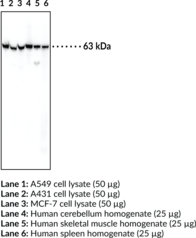
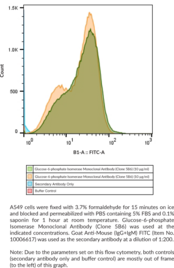
Glucose-6-phosphate isomerase (GPI) is a glycolytic enzyme that catalyzes the conversion of D-glucose-6-phosphate (Item No. 20376) to D-fructose-6-phosphate.1,2 It exists as a dimer where each monomer is composed of a large and small globular domain, which form a cleft that contains the catalytic active site, and a C-terminal tail.2,3 GPI is ubiquitously expressed and localized to the cytoplasm.1,2 It also functions as a neurotrophic growth factor and has a role in immunoglobulin synthesis.2 GPI is an autoantigen in rheumatoid arthritis (RA).4 Immunization with recombinant human GPI induces inflammatory cell infiltration, cartilage destruction, and bone erosion in the inflamed joints of mice, an effect that is reduced in Padi4 knockout mice, which lack peptidyl arginine deiminase 4 (PAD4), an enzyme involved in protein citrullination.5 Cayman's Glucose-6-phosphate Isomerase Monoclonal Antibody (Clone 5B6) can be used for ELISA, flow cytometry (FC), and Western blot (WB) applications. The antibody recognizes glucose-6-phosphate isomerase at 63 kDa from human samples.
WARNING This product is not for human or veterinary use.
References & Product Citations
1. Autoantibodies to GPI in rheumatoid arthritis: Linkage between an animal model and human disease. Nat. Immunol. 2(8), 746-753 (2001).
2. The crystal structure of a multifunctional protein: Phosphoglucose isomerase/autocrine motility factor/neuroleukin. Proc. Natl. Acad. Sci. USA 96(10), 5412-5417 (1999).
3. The crystal structure of glucose-
4. Anti-
5. Peptidylarginine deiminase type 4 deficiency reduced arthritis severity in a glucose-
Contact Info
Cayman Chemical1180 East Ellsworth RoadAnn Arbor, Michigan 48108 USAToll Free: (800) 364-9897(USA and Canada only)Fax: (734) 971-3640


