
Technical Support & Resources
Visit our FAQ
Contact Us
Toll Free Phone (USA and Canada Only): (888) 526-5351
Direct Phone: (734) 975-3888
Product Categories
Sphingosine Kinase 2 Monoclonal Antibody (Clone 2C6)
Item No. 31096
Technical Information
- SK2
- SPHK2
- SPK2
Shipping & Storage Information
Recommended Products
Certificates of Analysis & Batch Specific Data
Provide batch numbers separated by commas to download or request available product inserts, QC sheets, certificates of analysis, data packs, and GC-MS data.
Lipid Resource Center
Discover Products & Resources for Lipid Research
- High-purity lipid standards
- Lipid roles in biology
- Lipids in health & disease
- Lipids for pharmaceutical development
- Protocols, advice, & resources
Product Description
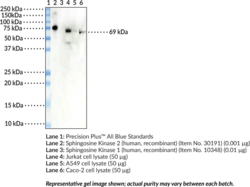
Sphingosine kinase 2 (SPHK2) is an ATP-dependent lipid kinase that is encoded by the SPHK2 gene in humans.1 It is composed of an N-terminal domain that contains an ATP binding site and a C-terminal domain that mediates substrate binding and specificity. SPHK2 is localized to the mitochondria, nucleus, and endoplasmic reticulum and is expressed in a wide variety of tissues, including the liver and kidney.2 Upon cellular stimulation with EGF, phorbol 12-myristate 13-acetate (PMA; Item No. 10008014), or FcεRI, SPHK2 is activated and catalyzes the phosphorylation of sphingosine to sphingosine-1-phosphate (S1P).3,1 SPHK2 has roles in many physiological and pathological processes, including cancer, inflammation, and neurodegenerative diseases.1,4,5,6,7 Unlike SPHK1, SPHK2-derived S1P increases apoptosis and inhibits cell growth in vitro.8,9,10 In vivo, hepatic SPHK2 regenerates S1P intracellularly after its dephosphorylation to sphingosine by the phospholipid phosphatase LPP3 at the cell membrane, which removes a portion of the sphingosine from the circulation. Therefore, inhibition of SPHK2 results in a paradoxical increase in circulating S1P levels as sphingosine returns to the circulation where it can be phosphorylated by SPHK1.11 Overexpression of SPHK2 increases intracellular calcium levels and induces apoptosis in NIH3T3 cancer cells and reduces LPS-induced increases in TNF-α and IL-6 levels in isolated human peripheral blood mononuclear cell-derived macrophages in vitro.4,5 SPHK2 activity is increased in postmortem frontal cortex from patients with Alzheimer's disease.7 Cayman’s Sphingosine Kinase 2 Monoclonal Antibody (Clone 2C6) can be used for ELISA and Western blot (WB) applications. The antibody recognizes SPHK2 at 69 kDa from human samples.
WARNING This product is not for human or veterinary use.
References & Product Citations
1. Mammalian sphingosine kinase (SphK) isoenzymes and isoform expression: Challenges for SphK as an oncotarget. Oncotarget 8(22), 36898-36929 (2017).
2. Molecular cloning and functional characterization of a novel mammalian sphingosine kinase type 2 isoform. The Journal of Biological Chemisty 275(26), 19513-19520 (2000).
3. Sphingosine kinase type 2 activation by ERK-
4. SphK1 and SphK2, sphingosine kinase isoenzymes with opposing functions in sphingolipid metabolism. The Journal of Biological Chemisty 280(44), 37118-37129 (2005).
5. Sphingosine kinase 2 is a negative regulator of inflammatory macrophage activation. Biochim. Biophys. Acta Mol. Cell Biol. Lipids 1864(9), 1235-1246 (2019).
6. Cutting edge: Modulation of intestinal autoimmunity and IL-
7. BACE1 activity is modulated by cell-
8. Sphingosine kinase type 2 is a putative BH3-
9. Sphingosine kinases, sphingosine-
10. "Dicing and splicing" sphingosine kinase and relevance to cancer. Int. J. Mol. Sci. 18(9), 1891 (2017).
11. Mechanism of sphingosine 1-
Contact Info
Cayman Chemical1180 East Ellsworth RoadAnn Arbor, Michigan 48108 USAToll Free: (800) 364-9897(USA and Canada only)Fax: (734) 971-3640


