
Technical Support & Resources
Information provided in the product description is from published literature. Due to the nature of scientific experimentation, your results (e.g., selectivity and effective concentrations) or specific application for this product may differ. If you have questions about how this product fits your application, please contact our technical support staff.
Visit our FAQ
Contact Us
Toll Free Phone (USA and Canada Only): (888) 526-5351
Direct Phone: (734) 975-3888
Product Categories

Technical Information
Shipping & Storage Information
Recommended Products
Certificates of Analysis & Batch Specific Data
Provide batch numbers separated by commas to download or request available product inserts, QC sheets, certificates of analysis, data packs, and GC-MS data.
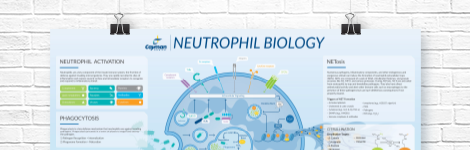
Neutrophil Biology Wall Poster
Explore how neutrophils shape the immune response in health and disease. This poster highlights neutrophil pathogen defense mechanisms, including phagocytosis, degranulation, and NETosis, as well as neutrophil roles in inflammation and NET-associated pathologies.
DOWNLOAD NOWProduct Description
Propionylpromazine is a promazine neuroleptic and dopamine receptor antagonist.1,2,3 It is an antagonist at the I. scapularis (tick) dopamine 2 receptor (Isdop2) and A. aegypti (mosquito) dopamine 2 receptor (AaDOP2), providing 94 and 85% inhibition, respectively, in a chemical screening assay at 10 µM.4,3 Propionylpromazine inhibits recombinant T. cruzi trypanothione reductase (IC50 = 357 µM) and is active against T. brucei trypomastigotes (ED50 = 10.1 µM) but not L. donovani amastigotes or T. cruzi trypomastigotes (ED50s = >30 µM) in mouse peritoneal macrophages.5 It increases survival of C. elegans in a model of paraquat-induced oxidative stress.6 Propionylpromazine reduces stereotypic behavior induced by apomorphine in rats (ED50 = 2.5 mg/kg, s.c.).1 Formulations containing propionylpromazine have been used as tranquilizers in veterinary medicine.
WARNING This product is not for human or veterinary use.
References & Product Citations
1. Biochemical actions of neuroleptic drugs: focus on the dopamine receptor. Handbook of psychopharmacology 37-55 (1978).
2. Discovery of antagonists of tick dopamine receptors via chemical library screening and comparative pharmacological analyses. Insect Biochem. Molec. 42(11), 846-853 (2012).
3. Phenothiazine inhibitors of trypanothione reductase as potential antitrypanosomal and antileishmanial drugs. J. Med. Chem. 41(2), 148-156 (1998).
4. A pharmacological network for lifespan extension in Caenorhabditis elegans. Aging Cell 13(2), 206-215 (2014).
Contact Info
Cayman Chemical1180 East Ellsworth RoadAnn Arbor, Michigan 48108 USAToll Free: (800) 364-9897(USA and Canada only)Fax: (734) 971-3640


