
Technical Support & Resources
Visit our FAQ
Contact Us
Toll Free Phone (USA and Canada Only): (888) 526-5351
Direct Phone: (734) 975-3888
Product Categories
Product Type
Research Area
Application
Technical Information
- 4-1BB Ligand Receptor
- CDw137
- ILA
- TNFRSF9
- Tumor Necrosis Factor Receptor Superfamily Member 9
Shipping & Storage Information
Recommended Products
Certificates of Analysis & Batch Specific Data
Provide batch numbers separated by commas to download or request available product inserts, QC sheets, certificates of analysis, data packs, and GC-MS data.

Explore Obesity & Metabolic Disease Resources
Discover high-quality research tools to investigate GLP-1 mechanisms and next-generation metabolic targets.
OBESITY RESEARCH SOLUTIONSProduct Description
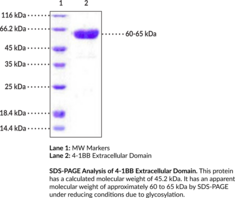
4-1BB, also known as CD137, is a type I transmembrane glycoprotein and member of the TNF receptor superfamily with roles in T cell-mediated immunity.1 It is composed of an N-terminal extracellular domain comprised of a signaling sequence and four cysteine-rich pseudo repeats (CRDs), a helical transmembrane domain, and a cytoplasmic signaling domain.2 4-1BB is transiently expressed on antigen-primed activated T cells, activated natural killer (NK) cells, and mature dendritic cells. Binding of homotrimeric 4-1BB ligand on antigen-primed T cells induces NF-κB and MAPK signaling through TNF receptor-associated factors (TRAFs) and, when the T cell is co-stimulated by other factors, induces PI3K signaling.3,1 This bidirectional signaling event promotes clonal expansion, differentiation, and survival of T cells, as well as polarizes T helper cells.4 Knockout of Tnfrsf9, the gene encoding 4-1BB, reduces pancreatic islet accumulation of β-cell-autoreactive CD8+ T cells in a mouse model of type 1 diabetes mellitus. Administration of an anti-4-1BB antibody prolongs survival and reverses renal damage, production of autoantibodies, and immune complex deposition in lupus-prone NZB X NZW F1 mice. Cayman’s 4-1BB/CD137 Extracellular Domain (human, recombinant) protein can be used for ELISA. This protein is a disulfide-linked homodimer. The reduced monomer, comprised of 4-1BB (amino acids 25-186) fused to His-tagged human IgG1 Fc at its C-terminus, consists of 409 amino acids, has a calculated molecular weight of 45.2 kDa, and a predicted N-terminus of Gln25 after signal peptide cleavage. As a result of glycosylation, the monomer migrates at approximately 60 to 65 kDa by SDS-PAGE under reducing conditions.
WARNING This product is not for human or veterinary use.
References & Product Citations
1. The TNF–TNFR family of co-
2. Structure of the 4-
3. A novel form of 4-
4. CD137 / CD137 ligand signalling regulates the immune balance: A potential target for novel immunotherapy of autoimmune diseases. J. Autoimmun. 112, 102499 (2020).
Contact Info
Cayman Chemical1180 East Ellsworth RoadAnn Arbor, Michigan 48108 USAToll Free: (800) 364-9897(USA and Canada only)Fax: (734) 971-3640


