
Technical Support & Resources
Visit our FAQ
Contact Us
Toll Free Phone (USA and Canada Only): (888) 526-5351
Direct Phone: (734) 975-3888
Technical Information
- CD27L
- TNFSF7
- TNF Superfamily Member 7
Shipping & Storage Information
Recommended Products
Certificates of Analysis & Batch Specific Data
Provide batch numbers separated by commas to download or request available product inserts, QC sheets, certificates of analysis, data packs, and GC-MS data.
Kinase Resource Center
Discover Products & Resources for Kinase Research
- Kinase inhibitors, screening libraries, assay kits, & more
- Tools to study kinase signaling pathways:
- Growth factor signaling
- PI3K/Akt/mTOR
- MAPKs (ERK, p38, & JNK)
- JAK/STAT signaling
- Articles, resources, & advice
Product Description
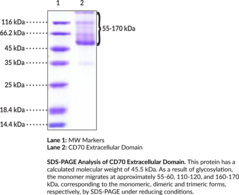
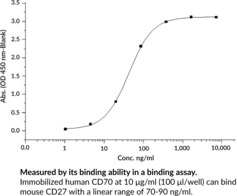
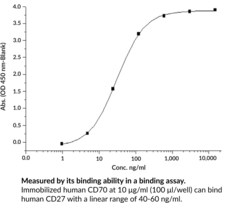
CD70, also known as CD27 ligand (CD27L), is a type II transmembrane glycoprotein and member of the tumor necrosis factor (TNF) ligand superfamily (TNFSF).1 It is comprised of an N-terminal extracellular domain, a transmembrane domain, a stalk region, and a C-terminal TNF homology domain and is exclusively expressed on activated T and B cells and mature dendritic cells.1,2,3 CD70 forms homotrimers and binds to its receptor, CD27 (Item No. 31828), on antigen-primed T cells, which induces NF-κB and MAPK signaling through TNF receptor-associated factors (TRAFs) and, when the T cell is stimulated by other factors, induces PI3K signaling to induce the co-stimulation and expansion of naïve CD4+ and CD8+ T cells.4,1 CD70 is overexpressed in various hematological malignancies and is associated with accelerated tumor cell proliferation.3 CD70 expression is negatively correlated with overall survival in patients with diffuse malignant mesothelioma of the pleura. Cayman’s CD27L/CD70 Extracellular Domain (human, recombinant) protein can be used for binding assay applications. This protein is a disulfide-linked homodimer. The reduced monomer, comprised of CD70 (amino acids 39-193) fused to human IgG Fc at its N-terminus, consists of 413 amino acids and has a calculated molecular weight of 45.5 kDa. As a result of glycosylation, the monomer migrates at approximately 55-60, 110-120, and 160-170 kDa, corresponding to the monomeric, dimeric and trimeric forms, respectively, by SDS-PAGE under reducing conditions.
WARNING This product is not for human or veterinary use.
References & Product Citations
1. Therapeutic targeting of CD70 and CD27. Expert Opin. Ther. Targets 20(8), 959-973 (2016).
2. CD27, a member of the tumor necrosis factor receptor family, induces apoptosis and binds to Siva, a proapoptotic protein. Proc. Natl. Acad. Sci. USA 94(12), 6346-6351 (1997).
3. CD70 expression correlates with a worse prognosis in malignant pleural mesothelioma patients via immune evasion and enhanced invasiveness. J. Pathol. 250(2), 205-216 (2020).
4. Trimer stabilization, oligomerization, and antibody-
Contact Info
Cayman Chemical1180 East Ellsworth RoadAnn Arbor, Michigan 48108 USAToll Free: (800) 364-9897(USA and Canada only)Fax: (734) 971-3640


