
Technical Support & Resources
Visit our FAQ
Contact Us
Toll Free Phone (USA and Canada Only): (888) 526-5351
Direct Phone: (734) 975-3888
Product Categories
Product Type
Application
Technical Information
- Activin-binding Protein
- FS
- FSH-suppressing Protein
- FST
Shipping & Storage Information
Recommended Products
Certificates of Analysis & Batch Specific Data
Provide batch numbers separated by commas to download or request available product inserts, QC sheets, certificates of analysis, data packs, and GC-MS data.
Kinase Resource Center
Discover Products & Resources for Kinase Research
- Kinase inhibitors, screening libraries, assay kits, & more
- Tools to study kinase signaling pathways:
- Growth factor signaling
- PI3K/Akt/mTOR
- MAPKs (ERK, p38, & JNK)
- JAK/STAT signaling
- Articles, resources, & advice
Product Description
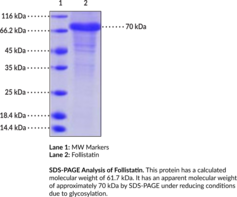
Follistatin is a glycoprotein with roles in the reproductive system, as well as during development and in cell growth and differentiation.1,2 It is composed of an N-terminal region, three 10-cysteine follistatin domains (FSDs), and a C-terminal segment.3 Alternative splicing of FST, the gene encoding follistatin, generates two isoforms: FS-288 and FS-315, which differ in the length of the C-terminal region, and a third isoform, FS-303, is formed through proteolytic cleavage of FS-315.3,1,4 Follistatin is ubiquitously expressed and primarily secreted but is found in the cytosol of certain cells.2,4 It binds to proteins in the TGF-β superfamily, including activin, inhibin, and myostatin, and prevents them from interacting with their respective receptors. This inhibition of TGF-β family proteins leads to a wide variety of effects on inflammation, immunity, muscle formation, and cancer, among others.1,5,6 Overexpression of FST in breast cancer cells in vitro reduces cell growth rate, and FST expression in breast cancer is associated with increased relapse-free survival.6 FST gene therapy increases muscle mass and reduces knee inflammation in a mouse model of high-fat diet-induced obesity and surgically induced osteoarthritis.7 Cayman’s Follistatin (human, recombinant) protein can be used for ELISA and binding assay applications. This protein is a disulfide-linked homodimer. The reduced monomer, composed of follistatin (amino acids 30-344) fused to human IgG1 Fc at its C-terminus, consists of 556 amino acids and has a calculated molecular weight of 61.7 kDa. As a result of glycosylation, the monomer migrates at approximately 70 kDa by SDS-PAGE under reducing conditions.
WARNING This product is not for human or veterinary use.
References & Product Citations
1. The emerging role of follistatin under stresses and its implications in diseases. Gene 639, 111-116 (2018).
2. Follistatin: A multifunctional regulatory protein. Front. Neuroendocrinol. 19(4), 287-322 (1998).
3. The role of follistatin domains in follistatin biological action. Mol. Endocrinol. 18(1), 228-240 (2004).
4. Too many follistatins: Racing inside and getting out of the cell. Endocrinology 146(12), 5048-5051 (2005).
5. The regulation and functions of activin and follistatin in inflammation and immunity. Vitam. Horm. 85, 255-297 (2011).
6. Increased expression of follistatin in breast cancer reduces invasiveness and clinically correlates with better survival. Cancer Genom. Proteom. 14(4), 241-251 (2017).
7. Gene therapy for follistatin mitigates systemic metabolic inflammation and post-
Contact Info
Cayman Chemical1180 East Ellsworth RoadAnn Arbor, Michigan 48108 USAToll Free: (800) 364-9897(USA and Canada only)Fax: (734) 971-3640


