
Technical Support & Resources
Visit our FAQ
Contact Us
Toll Free Phone (USA and Canada Only): (888) 526-5351
Direct Phone: (734) 975-3888
Product Categories
Product Type
Technical Information
- ATAR
- Herpes Virus Entry Mediator
- HVEA
- LIGHTR
- TNFRSF14
- TR2
- Tumor Necrosis Factor Receptor Superfamily Member 14
Shipping & Storage Information
Recommended Products
Certificates of Analysis & Batch Specific Data
Provide batch numbers separated by commas to download or request available product inserts, QC sheets, certificates of analysis, data packs, and GC-MS data.

Neutrophil Biology Wall Poster
Explore how neutrophils shape the immune response in health and disease. This poster highlights neutrophil pathogen defense mechanisms, including phagocytosis, degranulation, and NETosis, as well as neutrophil roles in inflammation and NET-associated pathologies.
DOWNLOAD NOWProduct Description
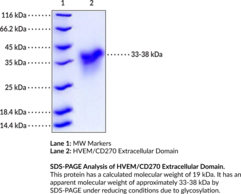
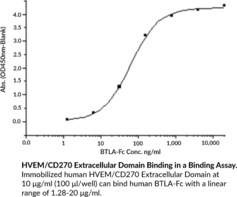
Herpes virus entry mediator (HVEM), also known as CD270, is a type I transmembrane glycoprotein encoded by TNFRSF14 in humans.1,2 It is composed of an extracellular domain containing four cysteine-rich repeats (CRDs), a transmembrane domain, and a cytoplasmic domain, which facilitates intracellular signaling. HVEM is expressed on T and B cells, other hematopoietic cells, and mucosal epithelium.2 It binds to B and T lymphocyte attenuator (BTLA), CD160, and LIGHT (Item No. 31841), also known as CD258, and induces co-activation or co-inhibition of T cells in a ligand-dependent manner via signaling through TNF receptor-associated factors (TRAFs) or inhibitory tyrosine-based motifs (ITIMs), respectively.2,3 Tnfrsf14-/- mice exhibit decreased susceptibility to bacterial infection, increased pro-inflammatory cytokine secretion and mortality in a model of concanavalin A-induced hepatitis, and increased susceptibility to the induction of experimental autoimmune encephalomyelitis (EAE), indicating roles for HVEM in both infection immunity and autoimmunity.4 Cayman’s HVEM/CD270 Extracellular Domain (human, recombinant) protein can be used for ELISA and enzyme activity assay applications. This protein consists of 177 amino acids and has a calculated molecular weight of 19 kDa. By SDS-PAGE, under reducing conditions, the apparent molecular mass of the protein is approximately 33 to 38 kDa due to glycosylation.
WARNING This product is not for human or veterinary use.
References & Product Citations
1. Structure-
2. Targeting the LIGHT-
3. HVEM: An unusual TNF receptor family member important for mucosal innate immune responses to microbes. Gut Microbes 4(2), 146-151 (2013).
4. Regulation of inflammation, autoimmunity, and infection immunity by HVEM-
Contact Info
Cayman Chemical1180 East Ellsworth RoadAnn Arbor, Michigan 48108 USAToll Free: (800) 364-9897(USA and Canada only)Fax: (734) 971-3640


