
Technical Support & Resources
Visit our FAQ
Contact Us
Toll Free Phone (USA and Canada Only): (888) 526-5351
Direct Phone: (734) 975-3888
Product Categories
Technical Information
- PDGFR2
- Platelet-derived Growth Factor Receptor 2
- Platelet-derived Growth Factor Receptor α
- RHEPDGFRA
Shipping & Storage Information
Recommended Products
Certificates of Analysis & Batch Specific Data
Provide batch numbers separated by commas to download or request available product inserts, QC sheets, certificates of analysis, data packs, and GC-MS data.
Kinase Resource Center
Discover Products & Resources for Kinase Research
- Kinase inhibitors, screening libraries, assay kits, & more
- Tools to study kinase signaling pathways:
- Growth factor signaling
- PI3K/Akt/mTOR
- MAPKs (ERK, p38, & JNK)
- JAK/STAT signaling
- Articles, resources, & advice
Product Description
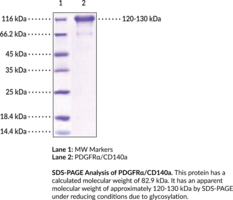
PDGFRα, also known as CD140a, is a type I transmembrane glycoprotein and receptor tyrosine kinase.1,2 It is composed of five extracellular immunoglobulin-like (Ig-like) domains, a transmembrane domain, and an intracellular kinase domain. PDGFRα is widely expressed and functions as a homodimer or a heterodimer with PDGFRβ.2 Binding of the growth factor PDGF-AA or PDGF-CC induces homodimerization, while binding of PDGF-BB or PDGF-AB can induce either homodimerization or heterodimerization with PDGFRβ.1 In each case, binding of the ligands induces receptor autophosphorylation and a conformational change that facilitates access to the intracellular kinase domain and intracellular signaling through multiple pathways, including ERK/MAPK, PI3K/AKT/mTOR, PLC/PKC, and JAK/STAT.1,2 Activating point mutations in PDGFRA, the gene encoding PDGFRα, are associated with gastrointestinal stromal tumors.2 PDGFRα can also fuse with FIP1L1, and the fusion protein has been found in patients with idiopathic hypereosinophilia. Cayman’s PDGFRα/CD140a (human, recombinant) protein can be used for binding activity assays. This protein is a disulfide-linked homodimer. The reduced monomer, composed of PDGFRα (amino acids 24-524) fused to human IgG1 Fc at its C-terminus, consists of 739 amino acids and has a calculated molecular weight of 82.9 kDa. As a result of glycosylation, the monomer migrates at approximately 120-130 kDa by SDS-PAGE under reducing conditions.
WARNING This product is not for human or veterinary use.
References & Product Citations
1. Structural and functional properties of platelet-
2. The role of small molecule platelet-
Contact Info
Cayman Chemical1180 East Ellsworth RoadAnn Arbor, Michigan 48108 USAToll Free: (800) 364-9897(USA and Canada only)Fax: (734) 971-3640


