
Technical Support & Resources
Visit our FAQ
Contact Us
Toll Free Phone (USA and Canada Only): (888) 526-5351
Direct Phone: (734) 975-3888
Product Categories
Application
Technical Information
- Activin Receptor-like Kinase 4
- Activin Receptor Type-1B
- ACTR1B
- ACVR1B
- ACVRLK4
- Serine/threonine-protein Kinase Receptor R2
- SKR2
Shipping & Storage Information
Recommended Products
Certificates of Analysis & Batch Specific Data
Provide batch numbers separated by commas to download or request available product inserts, QC sheets, certificates of analysis, data packs, and GC-MS data.

Explore Obesity & Metabolic Disease Resources
Discover high-quality research tools to investigate GLP-1 mechanisms and next-generation metabolic targets.
OBESITY RESEARCH SOLUTIONSProduct Description
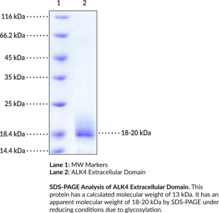
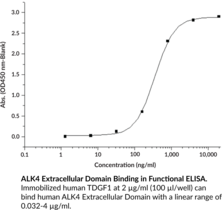
Activin receptor-like kinase 4 (ALK4) is a type I transmembrane glycoprotein, serine/threonine kinase, and member of the TGF-β superfamily that is encoded by ACVR1B in humans.1,2 It is composed of an extracellular ligand-binding domain, a single transmembrane domain, an intracellular serine/threonine kinase domain, and a cytoplasmic serine/threonine-rich region. ALK4 is ubiquitously expressed and forms heterodimers with activin receptor type IIA (ACTRIIA) or ACTRIIB at the cell surface. Upon ligand activation by activin A, activin B, activin AB, or Nodal, ALK4 is phosphorylated by its heterodimer partner and induces intracellular signaling and phosphorylation of SMAD2 and SMAD3 to regulate gene expression. ALK4-mediated signaling has roles in glucose-stimulated insulin secretion, neuronal differentiation of pluripotent stem cells, and the development of pancreatic and pituitary cancers.1,2,3 Cayman's ALK4 Extracellular Domain (human, recombinant) protein can be used for binding assays. This protein consists of 114 amino acids, has a calculated molecular weight of 13 kDa, and a predicted N-terminus of Ser24 after signal peptide cleavage. By SDS-PAGE, under reducing conditions, the apparent molecular mass of the protein is 18-20 kDa due to glycosylation.
WARNING This product is not for human or veterinary use.
References & Product Citations
1. Activin receptor-
2. Signal transduction pathway through activin receptors as a therapeutic target of musculoskeletal diseases and cancer. Endocr. J. 55(1), 11-21 (2008).
3. A role for TGFβ signalling in medium spiny neuron differentiation of human pluripotent stem cells. Neuronal Signal. 4(2), NS20200004 (2020).
Contact Info
Cayman Chemical1180 East Ellsworth RoadAnn Arbor, Michigan 48108 USAToll Free: (800) 364-9897(USA and Canada only)Fax: (734) 971-3640


