
Technical Support & Resources
Visit our FAQ
Contact Us
Toll Free Phone (USA and Canada Only): (888) 526-5351
Direct Phone: (734) 975-3888
Product Categories
Technical Information
- Activin Receptor-like Kinase 5
- Serine/threonine Protein Kinase Receptor 4
- SKR4
- TGF-βRI
- Transforming Growth Factor β Receptor Type I
Shipping & Storage Information
Recommended Products
Certificates of Analysis & Batch Specific Data
Provide batch numbers separated by commas to download or request available product inserts, QC sheets, certificates of analysis, data packs, and GC-MS data.
Kinase Resource Center
Discover Products & Resources for Kinase Research
- Kinase inhibitors, screening libraries, assay kits, & more
- Tools to study kinase signaling pathways:
- Growth factor signaling
- PI3K/Akt/mTOR
- MAPKs (ERK, p38, & JNK)
- JAK/STAT signaling
- Articles, resources, & advice
Product Description
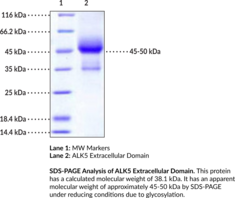
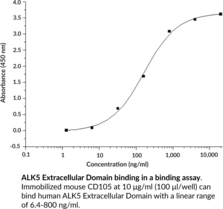
Activin receptor-like kinase 5 (ALK5), also known as TGF-β receptor type 1 (TGF-βRI), is a type I transmembrane glycoprotein, serine/threonine kinase, and member of the TGF-β superfamily that is ubiquitously expressed.1,2 It is composed of an extracellular ligand-binding domain, a single transmembrane domain, an intracellular serine/threonine kinase domain, and a cytoplasmic serine/threonine-rich region.1 The ALK5 ligand TGF-β mediates the formation of a complex that includes ALK5 and the type II transmembrane glycoprotein TGF-βRII, which phosphorylates ALK5 to induce intracellular signaling and phosphorylation of SMAD2 and SMAD3 to regulate gene expression.1,3 The ligands myostatin and growth differentiation factor 11 (GDF-11) induce formation of a complex between ALK5, TGF-βRI, activin receptor type 2A (ACTRIIA), and ACTRIIB to activate SMAD signaling in a similar manner. ALK5 signaling has roles in endothelial cell proliferation and migration, as well as angiogenesis.4,2 Mutations in TGFBR1 are associated with Loeys-Dietz syndrome, which is a connective tissue disorder characterized by a variety of mild-to-severe vascular defects, including aortic aneurysm.5 Cayman’s ALK5 Extracellular Domain (human, recombinant) protein can be used for binding assays. This protein is a disulfide-linked homodimer. The reduced monomer, composed of ALK5 (amino acids 34-125) fused to His-tagged human IgG1 Fc at its C-terminus, consists of 340 amino acids, has a calculated molecular weight of 38.1 kDa, and a predicted N-terminus of Leu34 after signal peptide cleavage. As a result of glycosylation, the monomer migrates at approximately 45-50 kDa by SDS-PAGE under reducing conditions.
WARNING This product is not for human or veterinary use.
References & Product Citations
1. Signal transduction pathway through activin receptors as a therapeutic target of musculoskeletal diseases and cancer. Endocr. J. 55(1), 11-21 (2008).
2. Regulation of endothelial cell plasticity by TGF-
3. TGF-
4. Balancing the activation state of the endothelium via two distinct TGF-
5. Angiotensin II-
Contact Info
Cayman Chemical1180 East Ellsworth RoadAnn Arbor, Michigan 48108 USAToll Free: (800) 364-9897(USA and Canada only)Fax: (734) 971-3640


