
Technical Support & Resources
Visit our FAQ
Contact Us
Toll Free Phone (USA and Canada Only): (888) 526-5351
Direct Phone: (734) 975-3888
Technical Information
- LEPD
- Obesity Factor
- OBS
Shipping & Storage Information
Recommended Products
Certificates of Analysis & Batch Specific Data
Provide batch numbers separated by commas to download or request available product inserts, QC sheets, certificates of analysis, data packs, and GC-MS data.

Explore Obesity & Metabolic Disease Resources
Discover high-quality research tools to investigate GLP-1 mechanisms and next-generation metabolic targets.
OBESITY RESEARCH SOLUTIONSProduct Description
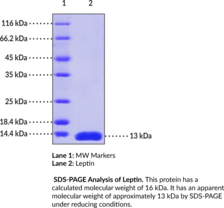
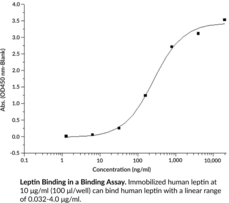
Leptin is a peptide hormone that regulates energy homeostasis, growth, and reproduction, as well as immune function.1 It is secreted by adipocytes and regulated by nutritional status, where fasting reduces leptin levels and feeding increases leptin levels, as well as in a circadian manner, with serum levels peaking at night.2,3 Circulating leptin can bind leptin receptors expressed by peripheral immune cells, such as macrophages, natural (NK) cells, and B and T cells, or be transported across the blood brain barrier, where it binds to neuronally expressed leptin receptors.1 Binding of leptin to the leptin receptor induces the recruitment and phosphorylation of JAK2, leading to activation of a variety of intracellular signaling cascades, including MAPK-, STAT-, PI3K-, and AMPK-mediated pathways.2 Leptin-dependent signaling pathways promote energy expenditure, growth, and reproductive functions, reduce food intake and the production of adrenal corticosteroids, and enhance innate and adaptive immune responses.1 Leptin-deficient ob/ob mice exhibit severe obesity, hyperlipidemia, hyperglycemia, and hyperinsulinemia and are a commonly used model of obesity and type 2 diabetes.4 Serum leptin levels are increased in individuals with a variety of conditions, including obesity or insulin resistance.5 Cayman's Leptin (human, recombinant) protein can be used for binding assays. The protein was synthesized from a DNA sequence encoding the mature form of human leptin (Val22-Cys167) with an N-terminal translation-initiating methionine (Met1). The expressed protein consists of 147 amino acids, has a calculated molecular weight of 16 kDa, and a predicted N-terminus of Met1.
WARNING This product is not for human or veterinary use.
References & Product Citations
1. Leptin and the maintenance of elevated body weight. Nat. Rev. Neurosci. 19(2), 95-105 (2018).
2. Structure, production and signaling of leptin. Metabolism 64(1), 13-23 (2015).
3. Effect of circadian rhythm on metabolic processes and the regulation of energy balance. Ann. Nutr. Metab. 74(4), 322-330 (2019).
4. Leptin-
5. Insulin-
Contact Info
Cayman Chemical1180 East Ellsworth RoadAnn Arbor, Michigan 48108 USAToll Free: (800) 364-9897(USA and Canada only)Fax: (734) 971-3640


