
Technical Support & Resources
Visit our FAQ
Contact Us
Toll Free Phone (USA and Canada Only): (888) 526-5351
Direct Phone: (734) 975-3888
Product Categories
Product Type
Application
GITRL Extracellular Domain (human, recombinant)
Item No. 32018
Technical Information
- AITRL
- Glucocorticoid-induced TNF-Related Ligand
- TNFSF18
- Tumor Necrosis Factor Ligand Superfamily Member 18
Shipping & Storage Information
Recommended Products
Certificates of Analysis & Batch Specific Data
Provide batch numbers separated by commas to download or request available product inserts, QC sheets, certificates of analysis, data packs, and GC-MS data.

Visit Our Cancer Resource Center
Find Tools & Resources to Study the Hallmarks of Cancer
- Cancer cell signaling & regulation
- Cancer metabolism
- Tumor microenvironment
Product Description
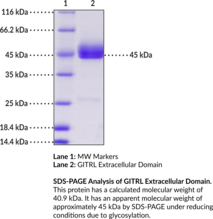
Glucocorticoid-induced TNF-related ligand (GITRL), also known as TNF superfamily member 18 (TNFSF18), is a type II transmembrane glycoprotein and member of the TNF superfamily with roles in adaptive immunity.1 It is composed of an N-terminal cytoplasmic domain, a transmembrane domain, and a C-terminal extracellular domain that binds to its receptor GITR (Item No. 32017) on T cells to regulate their activity. GITRL is expressed on professional and non-professional antigen-presenting cells, including B cells, monocytes, unstimulated myeloid dendritic cells, and plasmacytoid dendritic cell precursors, as well as microvascular-derived endothelial cells. GITRL co-stimulation increases activation and proliferation of T cell receptor-triggered effector T cells. It also enhances the activity of effector T cells by binding to regulatory T cells and inhibiting their activity. Upregulation of dendritic cell Gitrl levels suppresses regulatory T cell function, enhances effector T cell function, and delays tumor progression in a murine Lewis lung carcinoma model.2 Serum and synovial fluid levels of GITRL are increased and positively correlated with autoantibody production in patients with rheumatoid arthritis.3 Serum levels of GITRL are positively correlated with disease progression in patients with Sjögren syndrome.4 Cayman’s GITRL Extracellular Domain (human, recombinant) protein is a disulfide-linked homodimer. The reduced monomer, comprised of the GITRL extracellular domain (amino acids 72-199) fused to mouse IgG2a Fc at its C-terminus, consists of 361 amino acids and has a calculated molecular weight of 40.9 kDa. As a result of glycosylation, the monomer migrates at approximately 45 kDa by SDS-PAGE under reducing conditions.
WARNING This product is not for human or veterinary use.
References & Product Citations
1. GITR: A modulator of immune response and inflammation. Therapeutic Targets of the TNF Superfamily 647, 156-173 (2009).
2. Up-
3. GITRL is associated with increased autoantibody production in patients with rheumatoid arthritis. Clin. Rheumatol. 35(9), 2195-2202 (2016).
4. Increased GITRL impairs the function of myeloid-
Contact Info
Cayman Chemical1180 East Ellsworth RoadAnn Arbor, Michigan 48108 USAToll Free: (800) 364-9897(USA and Canada only)Fax: (734) 971-3640


