
Technical Support & Resources
Visit our FAQ
Contact Us
Toll Free Phone (USA and Canada Only): (888) 526-5351
Direct Phone: (734) 975-3888
Product Categories
Product Type
Research Area
Technical Information
- Protein Tyrosine Phosphatase Non-receptor Type 2
- Tyrosine Protein Phosphatase Non-receptor Type 2
Shipping & Storage Information
Recommended Products
Certificates of Analysis & Batch Specific Data
Provide batch numbers separated by commas to download or request available product inserts, QC sheets, certificates of analysis, data packs, and GC-MS data.

Explore Obesity & Metabolic Disease Resources
Discover high-quality research tools to investigate GLP-1 mechanisms and next-generation metabolic targets.
OBESITY RESEARCH SOLUTIONSProduct Description
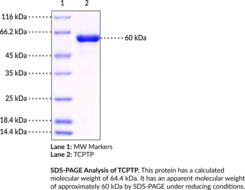
T cell protein tyrosine phosphatase (TCPTP) is a tyrosine phosphatase encoded by PTPN2 in humans.1 Two splice variants of TCPTP are expressed that contain identical N-termini and catalytic domains but varied C-termini: a 48 kDa form that contains a hydrophobic motif and is targeted to the endoplasmic reticulum and a 45 kDa form that is targeted to the nucleus by a bipartite nuclear localization sequence.1,2 TCPTP is expressed at high levels in cells of hematopoietic origin but is also ubiquitously expressed in all tissues and cell types.1 Although the 45 kDa variant of TCPTP is nuclear localized in resting cells, it exits the nucleus in response to various cellular stimuli to dephosphorylate substrates in the cytoplasm and plasma membrane, including PDGFR, c-Met, Src, JAK1, and STAT1, to regulate cell signaling. Knockdown of Ptpn2 induces growth retardation, anemia, increased levels of circulating proinflammatory cytokines, diarrhea, and death in mice by 3 to 5 weeks of age. Protein levels of TCPTP are reduced in BT-483, MDA-MB-134, MDA-MB-157, and MDA-MB-175 breast cancer cells and overexpression of PTPN2 suppresses cell growth in MDA-MB-175 and BT-483 cells.2 PTPN2 SNPs have been linked to the development of type I diabetes, rheumatoid arthritis, and Crohn’s disease.3 Cayman’s TCPTP (human, recombinant; aa 1-314) protein can be used for enzyme activity applications. This protein consists of 551 amino acids and has a calculated molecular weight of 64.4 kDa. By SDS-PAGE, under reducing conditions, the apparent molecular mass of the protein is 60 kDa.
WARNING This product is not for human or veterinary use.
References & Product Citations
1. PTP1B and TCPTP – nonredundant phosphatases in insulin signaling and glucose homeostasis. FEBS J. 280(2), 445-458 (2013).
2. TCPTP regulates SFK and STAT3 signaling and is lost in triple-
3. T cell protein tyrosine phosphatase attenuates T cell signaling to maintain tolerance in mice. J. Clin. Invest. 121(12), 4758-4774 (2011).
Contact Info
Cayman Chemical1180 East Ellsworth RoadAnn Arbor, Michigan 48108 USAToll Free: (800) 364-9897(USA and Canada only)Fax: (734) 971-3640


