
Technical Support & Resources
Visit our FAQ
Contact Us
Toll Free Phone (USA and Canada Only): (888) 526-5351
Direct Phone: (734) 975-3888
Technical Information
- Epidermal Growth Factor Receptor
- ErbB-1
- HER1
Shipping & Storage Information
Recommended Products
Certificates of Analysis & Batch Specific Data
Provide batch numbers separated by commas to download or request available product inserts, QC sheets, certificates of analysis, data packs, and GC-MS data.
Kinase Resource Center
Discover Products & Resources for Kinase Research
- Kinase inhibitors, screening libraries, assay kits, & more
- Tools to study kinase signaling pathways:
- Growth factor signaling
- PI3K/Akt/mTOR
- MAPKs (ERK, p38, & JNK)
- JAK/STAT signaling
- Articles, resources, & advice
Product Description
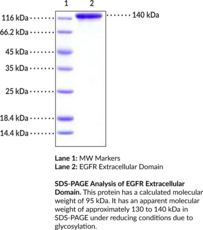
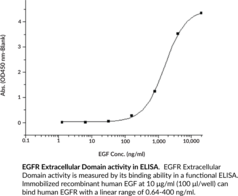
Epidermal growth factor receptor (EGFR), also known as HER1 and ERBB1, is a cell surface receptor and member of the EGF family of receptor tyrosine kinases with roles in cell proliferation, differentiation, and survival.1,2 It is a 170 kDa transmembrane receptor composed of an intracellular tyrosine kinase domain, a transmembrane lipophilic segment, and an extracellular domain that is expressed in epithelial, mesenchymal, and neuronal tissues.1,2,3 Under unstimulated conditions, EGFR is an auto-inhibited monomer in the plasma membrane.1 Upon canonical ligand binding, EGFR undergoes homodimerization or heterodimerization with HER2, HER3, or HER4, which induces a conformational change in the cytoplasmic domain that facilitates autophosphorylation and intracellular signaling. EGFR inhibits autophagy under nutrient-rich growth conditions and, conversely, induces autophagy under serum-starved conditions by interacting with the autophagy inhibitor Rubicon to induce its dissociation from Beclin-1. Overexpression of EGFR is found in multiple solid tumors, including renal, breast, ovarian, and head and neck cancer, as well as non-small cell lung cancer (NSCLC).2 EGFRL858R is associated with increased susceptibility to tyrosine kinase inhibition and cell death, while EGFRT790M is associated with kinase inhibitor resistance in NSCLC.4 Inhibition of EGFR reduces angiotensin II-induced cardiac hypertrophy in mice.5 Cayman’s EGFR Extracellular Domain (human, recombinant) protein can be used for ELISA. This protein is a disulfide-linked homodimer. The reduced monomer, comprised of the EGFR extracellular domain (amino acids 25-645) fused to human IgG1 Fc at its C-terminus, consists of 860 amino acids and has a calculated molecular weight of 95 kDa, and a predicted N-terminus of Leu25 after signal peptide cleavage. As a result of glycosylation, the monomer migrates at approximately 130 to 140 kDa by SDS-PAGE under reducing conditions.
WARNING This product is not for human or veterinary use.
References & Product Citations
1. Emerging functions of the EGFR in cancer. Mol. Oncol. 12(1), 3-20 (2018).
2. Review of epidermal growth factor receptor biology. Int. J. Radiat. Oncol. Biol. Phys. 59(2 Suppl), 21-26 (2004).
3. Distribution and function of EGFR in human tissue and the effect of EGFR tyrosine kinase inhibition. Anticancer Res. 23(5A), 3639-3650 (2003).
4. Overcoming EGFR(T790M) and EGFR(C797S) resistance with mutant-
5. Novel EGFR inhibitors attenuate cardiac hypertrophy induced by angiotensin II. J. Cell. Mol. Med. 20(3), 482-494 (2016).
Contact Info
Cayman Chemical1180 East Ellsworth RoadAnn Arbor, Michigan 48108 USAToll Free: (800) 364-9897(USA and Canada only)Fax: (734) 971-3640


